The Black Scare and the Party of Anarchy
:Notes from the Philippines on the Second Battle of Mendiola


In August 2025, a powerful uprising shook Indonesia and spread rapidly throughout the region, helping to catalyze a revolution in Nepal. Yet even as it set off further explosions from the Philippines to Morocco, this momentum hit a wall everywhere as governments counterattacked with repression specifically targeting anarchists—in what some in the region have called the “black scare.” In the following analysis, Simoun Magsalin draws on the events in the Philippines to outline the challenges confronting today’s revolutionaries and explore what it will take to overcome them.
You can read a full account of the confrontation that took place in Manila, the Philippine capital, on September 21, 2025 here.
You can support the black scare detainees and defendants from the Philippines who were arrested at Mendiola on September 21, 2025 through Durian Distro, which is handling international donations via Ko-Fi. Please include a message noting that your donation is for the 9/21 prisoners. Salamat po!
You can support Indonesian prisoners via Serikat Tahanan or the Serikat Napi Lintas-Lapas / Inter-Correctional Prisoner Union. Please use the “Donasi” button on their website. Terima kasih!
This line of inquiry is equally relevant in North America, as anarchists confront intensifying repression from Prairieland to Minneapolis.
9/21 and the Party of Anarchy
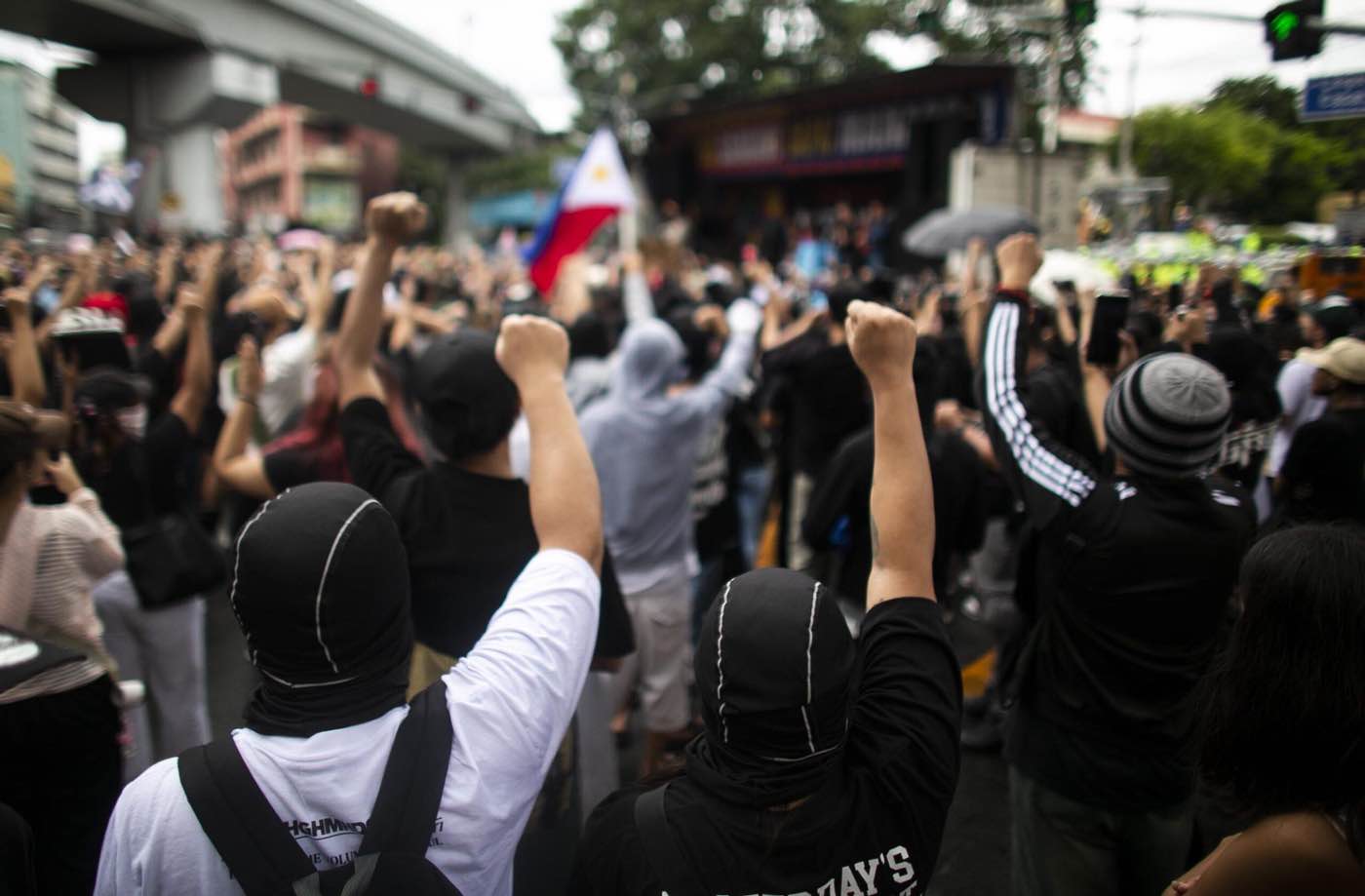
On September 21, 2025, a host of leftists, socialists, and pro-revolutionaries marched at the fateful site where the Spanish colonial government executed José Rizal on December 30, 1896. Rizal was executed under false charges for an anti-colonial insurrection he had little to do with but which had proclaimed him as its north star. In 2025, a march of more than 80,000 Filipinos assembled by the monument where his remains are interred to express outrage in response to a massive corruption scandal involving the graft of funds designated for flood control infrastructure projects—the plunder of which through fraudulent projects caused numerous deaths across multiple tropical typhoons.
For months before the march, the outrage had led nowhere, as the Philippine left was at an almost-historic nadir after years of opportunism, repression, and dynastic restoration from the previous Duterte presidency and the continuation of Dutertismo in the current administration headed by Ferdinand “Bongbong” Marcos, Jr. Morale was so low that a leftist attempt to organize a general assembly in an urban poor community facing demolition apparently drew almost no one. At a factory strike, the workers self-managed their picket to limit and pacify their own actions.
Yet the insurrection that broke out in Indonesia at the end of August 2025 inspired something in Filipinos. Militants from National Democracy organized limited direct action at the beginning of September, involving publicized vandalism and minor street fighting. They hoped to arouse “the masses” from slumber and invoke spontaneity. Alas, such energy did not arise—at least, not at first. Then the insurrection in Nepal bloomed and then withered, and morale rose once again. To know that power is vulnerable elsewhere is to see that it is vulnerable everywhere.
Photograph by Philippine Collegian.
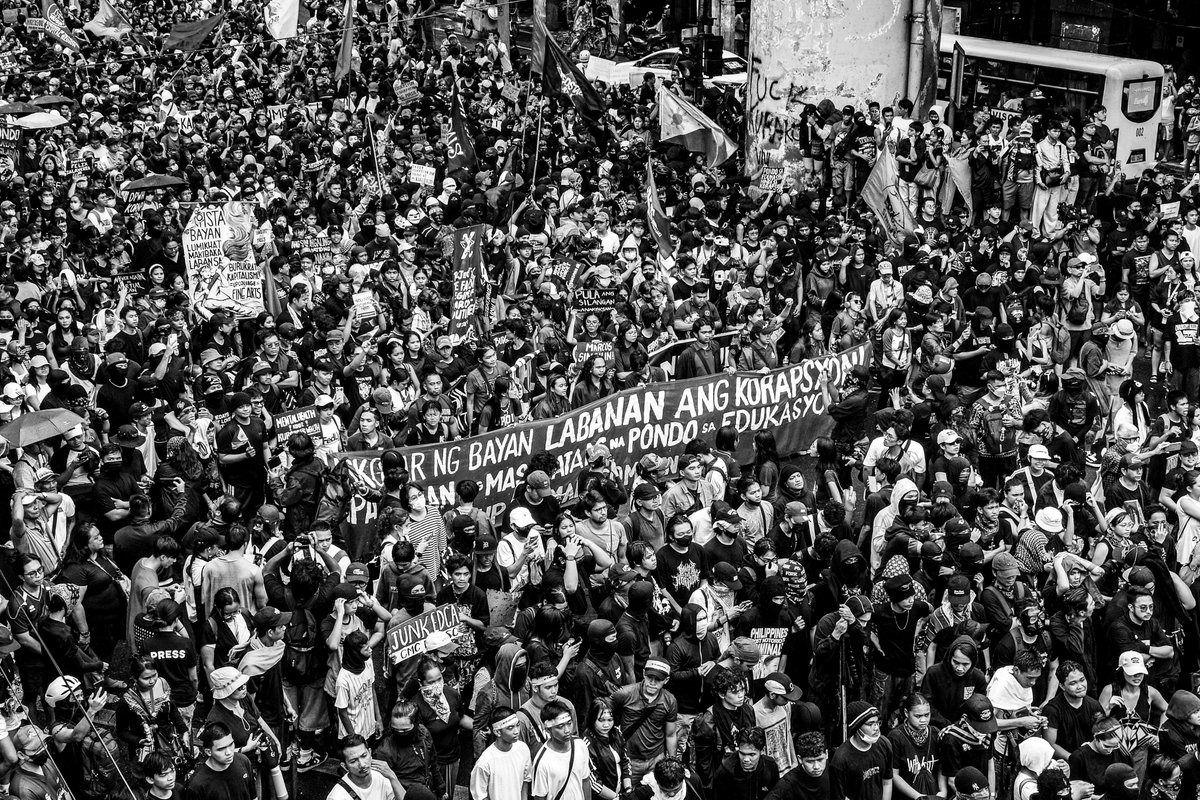
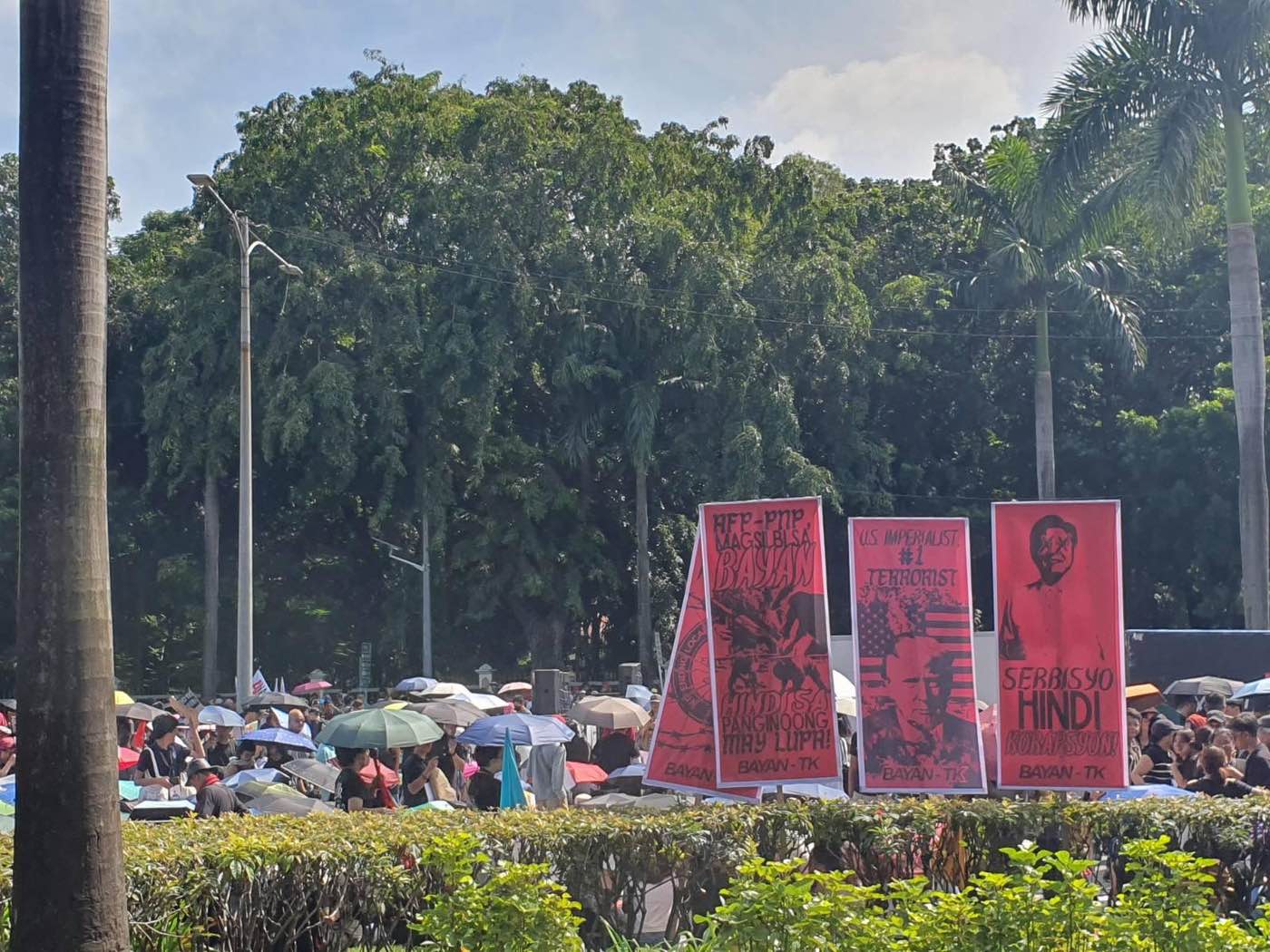
Several groups announced a mass mobilization for September 21 at Luneta and at EDSA.1 The Catholic Church was one of the biggest forces that organized mobilizations, followed by various right-wing, liberal, social democratic, National Democratic, and socialist groups. Anarchists of various persuasions were there, too, in our own fashion. Banners of all kinds were on display: the National Democratic Mass Organizations (NDMOs) and Makabayan, the bloc of Sanlakas-PLM-BMP-Oriang, Akbayan, Kilusan, Kamanggagawa, Partido Sosyalista, the Spartacists, Partido Manggagawa, Manibela and other workers’ associations, and university fraternities. The right-wing Duterte Diehard Supporters (DDS)2 were there too, some projecting phrase-mongering into the military base to spontaneously induce a kudeta (Tagalog for “coup d’état”3) among the generals in a vain attempt to oust President Bongbong Marcos, catapult Vice President Sara Duterte to the highest office, and (somehow?) bring former president Rodrigo Duterte back home from his incarceration at the Hague by the International Criminal Court.4
On the margins of all these parties was another: the party of anarchy.5
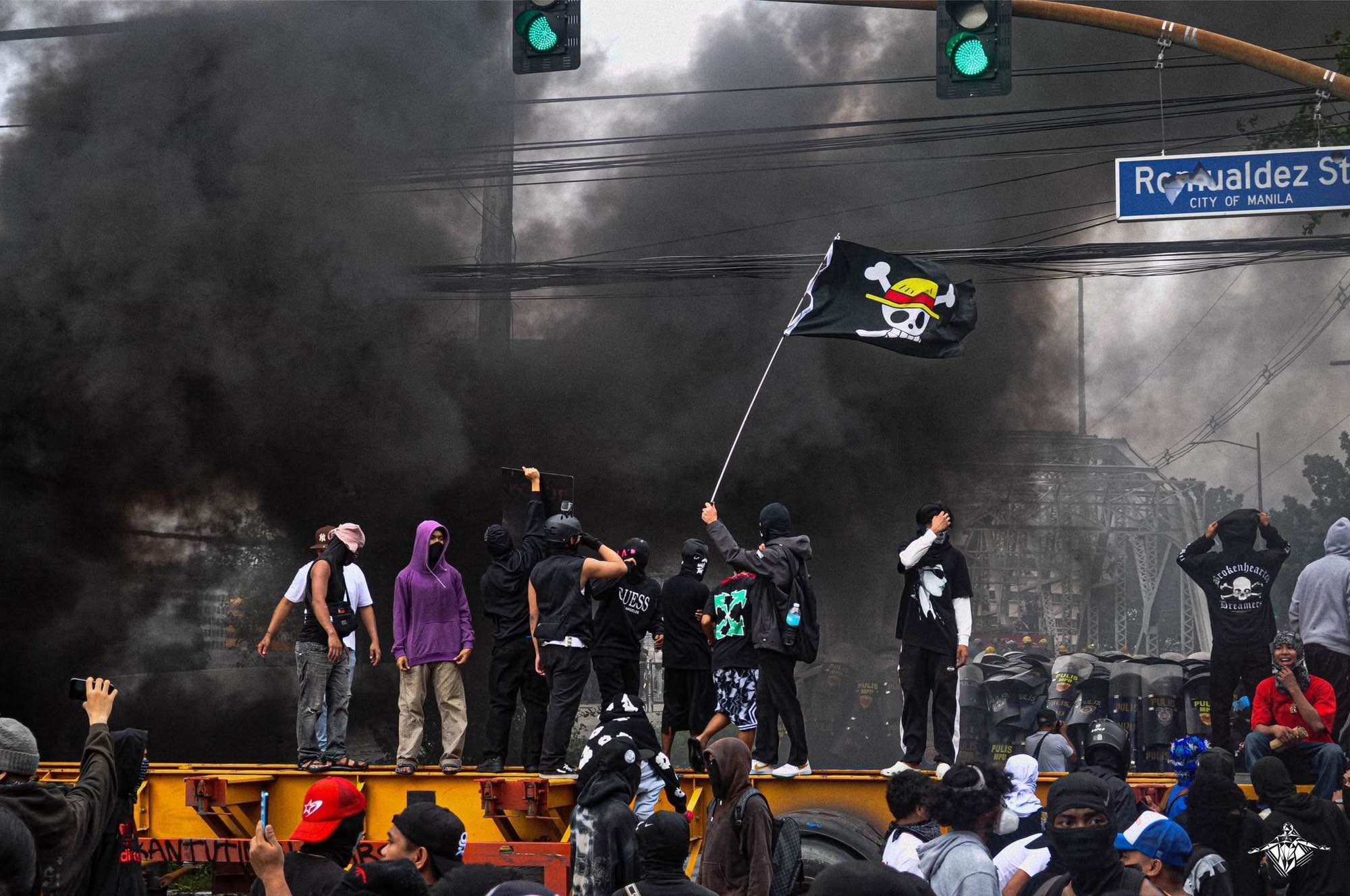
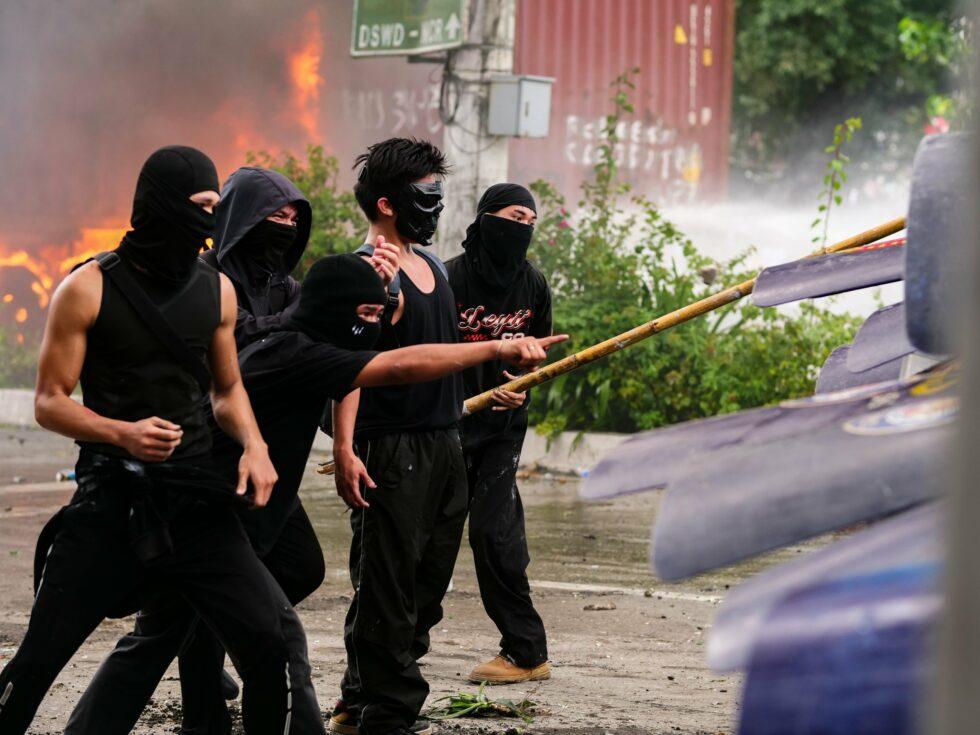
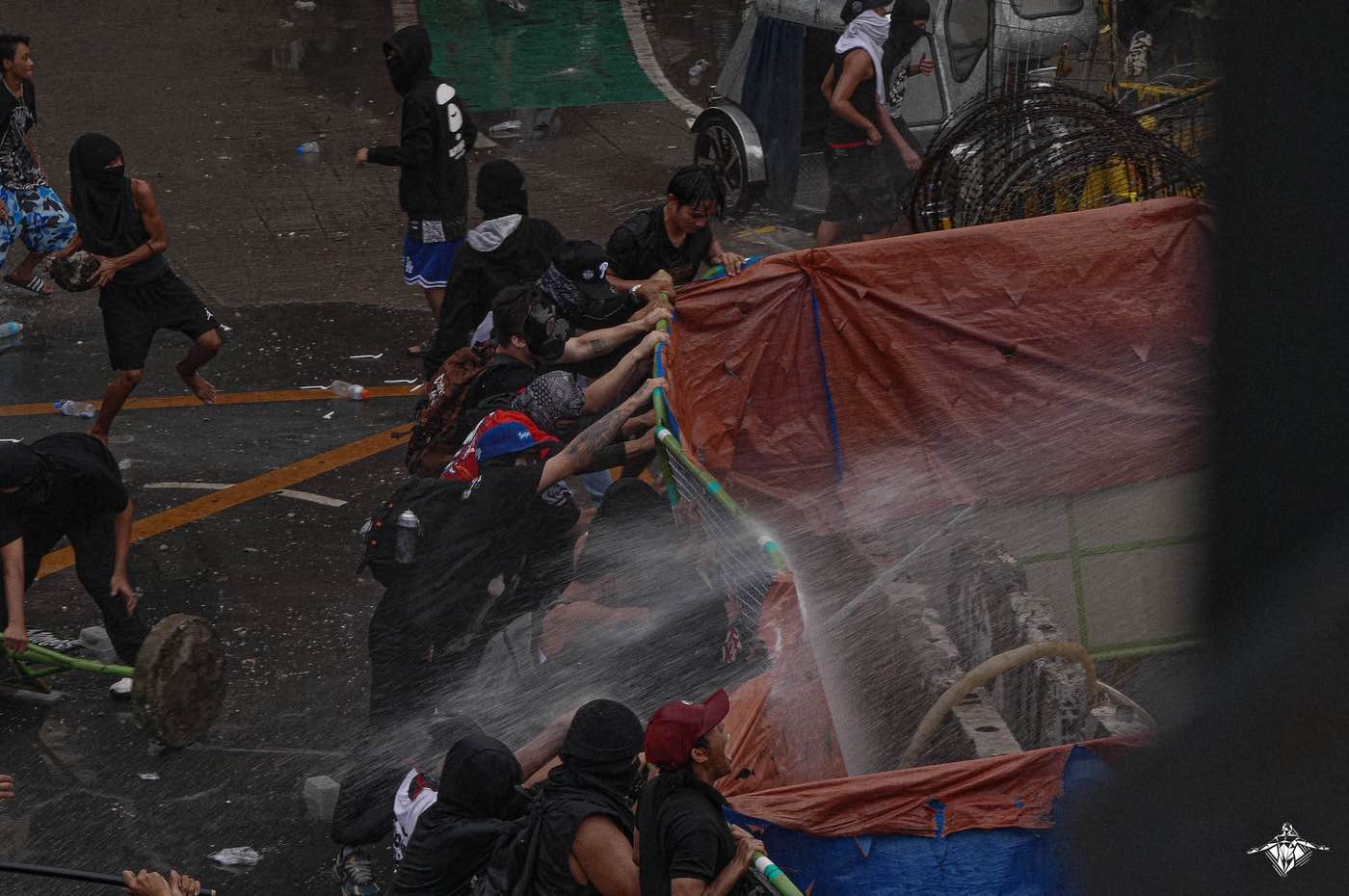
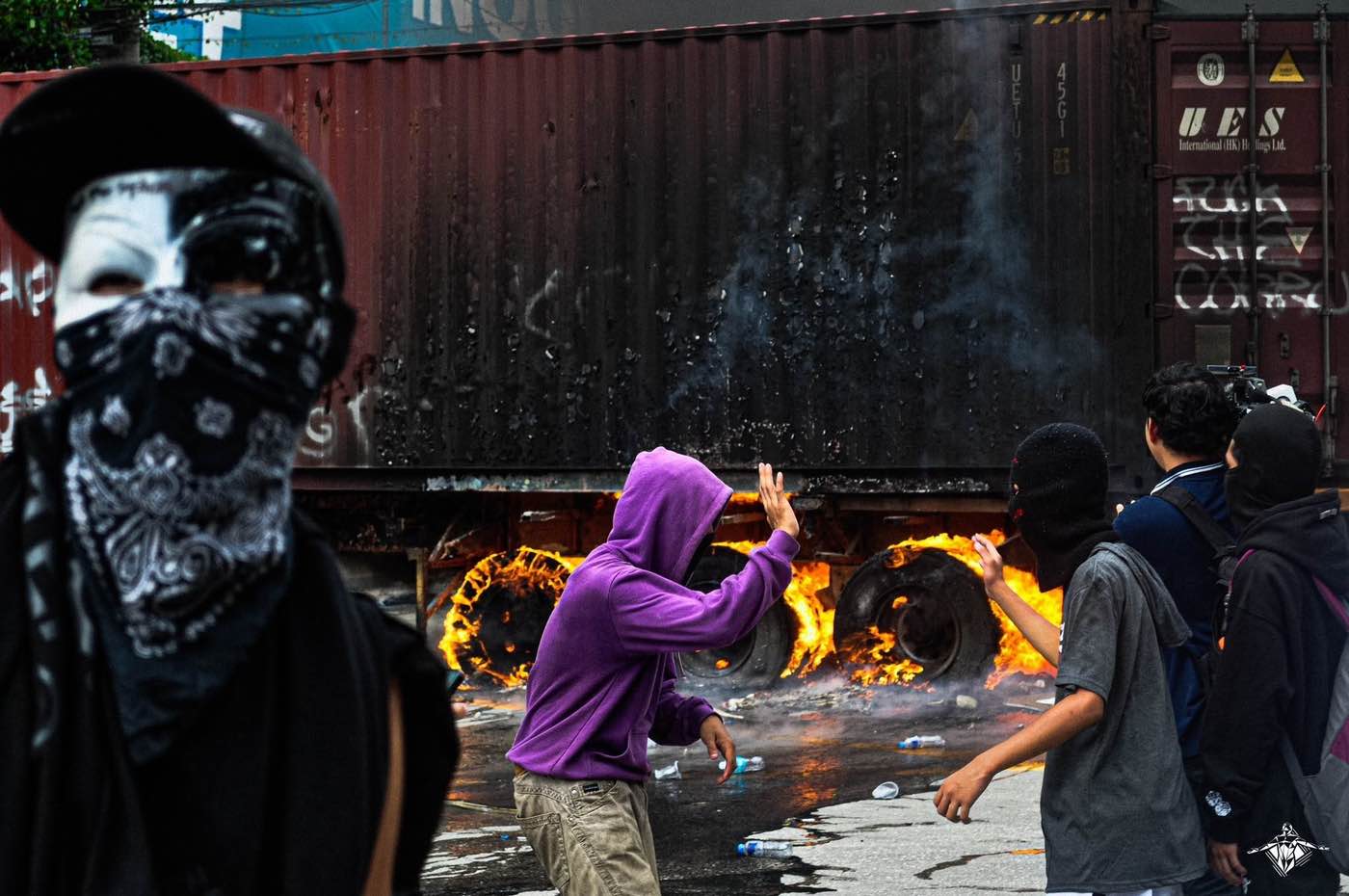
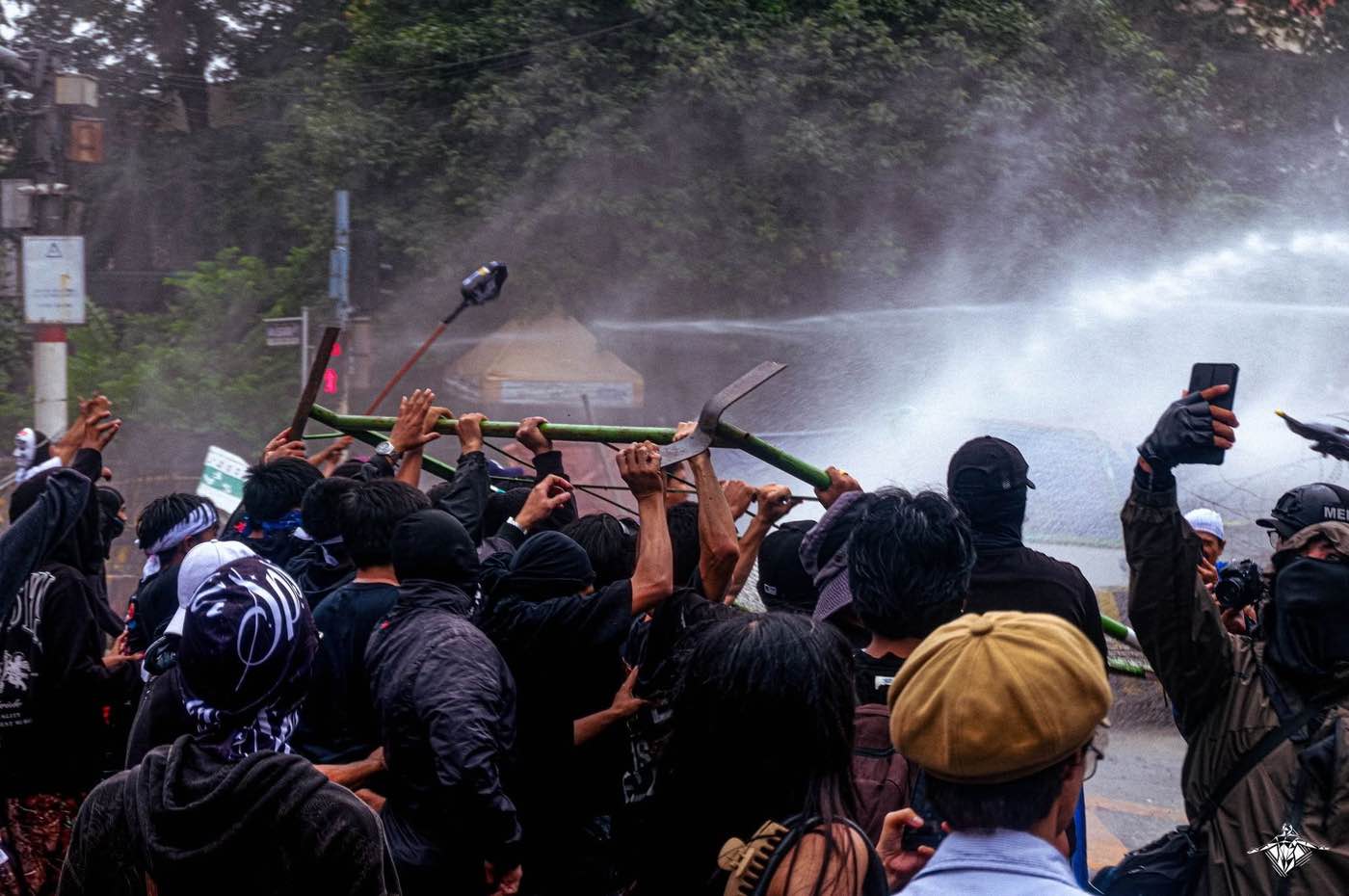
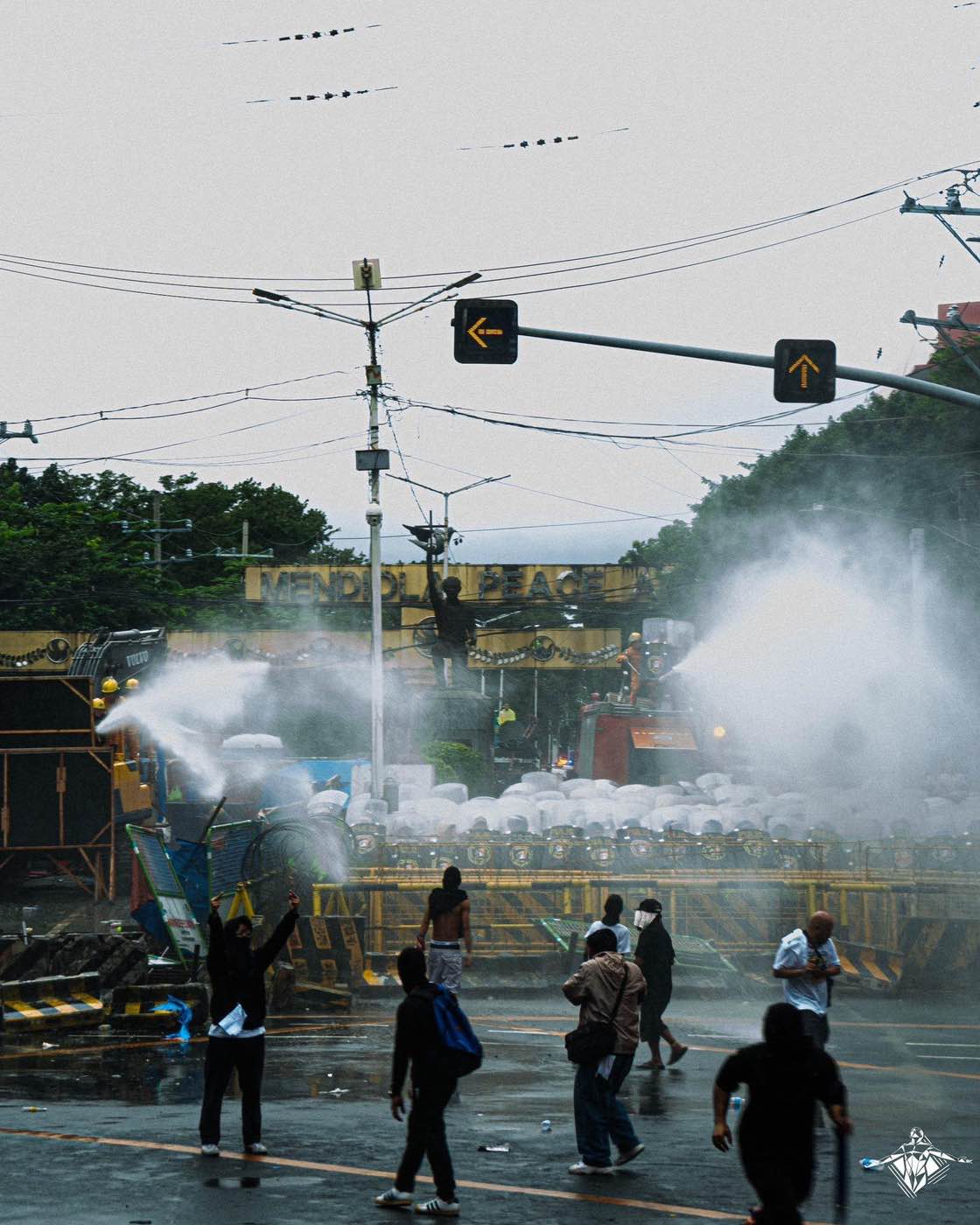
After the protest march program of the Makabayan bloc ended on the way to Mendiola, black-clad youth initiated violent direct action, attempting to set fire to a freight truck used as a police barricade and then lobbing rocks at the police. The police struck back with their own rocks, trapping the militants from Makabayan in the crossfire. At that moment, another wing of the party of anarchy revealed itself, opening up another front in the Philippines just as had occurred in Indonesia and Nepal. The same sigils of the One-Piece straw-hat skull-and-bones flag flew again, raised by those in anarchistic black attire.
The spontaneous movement of September 21 (or 9/21) was no party of anarchists, much as we might wish they were. Neither were they self-identifying National Democrats, Maoists, socialists, or communists—nor fascists, though fascists want to appropriate the symbolism and significance of the 9/21 events.6
The party of anarchy is not a particular organizational formation, but a spontaneous emergence that cohered at a time of high morale among our class. As in Indonesia and Nepal, it emerged outside the milieu known as the “left.” But how the self-ascribed left relates to this party of anarchy is of crucial importance, especially in view of how quickly some on the left sought to denounce the militants as “anarchists,” fascists, Dutertistas, or (Chinese?) saboteurs.
cdn.crimethinc.com/assets/articles/2026/06/30/7.jpg
The Black Scare and the Party of Order
The party of anarchy that emerged at the battle of Mendiola was small. The majority of the (at least) 277 detainees at Mendiola were not involved in the direct action at all or else were not anarchists. Many were innocent bystanders, some of whom were colonized minorities within the Philippine nation-state who didn’t even speak Tagalog and were in Manila for less than a week. Another was a student journalist who just happened to wear black to the protest and was illegally detained only because he looked vaguely like an anarchist. Around or at least 91 of the Mendiola detainees were legally minors. All were beaten on the streets and then systematically tortured, denied legal representation, denied food and medicine, and denied access to their families.
Yet despite not being partisanos of the party of anarchy, they were red-tagged7 (black-tagged?) as “anarchists.” By then, this was a familiar refrain, coming as it did on the heels of the black scare in Indonesia that saw the open hunting of anarchists by Prabowo’s decree, as well as Trump’s criminalization order targeting so-called “antifa” in the United States and the accusations of Nepali politicians that anarchists had “infiltrated” the insurrection there. In September 2025, security forces were conjuring whole parties of anarchists out of the air to explain various riots and insurrectionary episodes across the world, each imagined conspiracy more fanciful than the last. If only such revolutionaries could be born fully armored and ready to fight, like a hundred thousand Athenas born from the mind of Zeus!
Conspiratorial baiting of this kind is not new. In the wake of October 7, 2023, whole battalions of Hamas were identified all across the world. Paragliders in the middle of Britain? Hamas. Students occupying campuses to protest investments in the genocide in Gaza and the occupation of Palestine? Hamas. Jewish anti-Zionists? Hamas. Random people on the train who don’t look like me and aren’t bothering anyone? Hamas! As with earlier waves of red-baiting, “Hamas-baiting” and the current black scare serve to delegitimize and criminalize protest and organizing, whether in response to the Israeli genocide of Palestinians in Gaza or the brazen corruption scandals in Asia and elsewhere.
We’ve seen how black-tagging and the black scare has been deployed in Indonesia, Nepal, and the Philippines in much the same way that red-baiting was used in the past. It didn’t matter whether you were an anarchist or a social democrat—you will be red-baited and deported or imprisoned as a filthy godless communist! Non-state actors including liberals and yellow unions have used red-tagging to delegitimize their ideological rivals in the electoral or labor-union arena. Now, in a similar way, just being some kind of leftist, wearing black, or being at the wrong place at the wrong time can get you black-tagged as an anarchist and threatened with subversion charges. We saw this in Indonesia and Nepal and again at Mendiola. In a consistent, predictable way, the party of order uses the black scare strategy to suppress not only the party of anarchy, but all who criticize the prevailing order.
What is the party of anarchy, really? It is not something that can be constructed the way you construct a formal party. It is constituted and coheres on the basis of a social insurrection, or at least the beginnings of one. It is on this basis that the party of anarchy is not merely a threat to the dominant wing of the party of order—the caucus of the existent—but also to the caucus of the false critics, who conduct a two-line struggle within the party of order but remain its loyal opposition. The black scare, then, works slightly differently than the red scare in terms of how the caucus of the false critics uses it to target the party of anarchy.
In the immediate aftermath of the police repression at Mendiola, another parallel narrative began to form. The direct actionists and the Mendiola detainees were at the pay of foreign agents, or of Sara Duterte—or so many commenters said. Liberals and leftists alike repeated this ad nauseam. The caucus of the false critics is constantly negotiating their place within the party of order and within the broader effort to reimpose normalcy. The black scare is used by these false critics to dissolve the party of anarchy in order to achieve that purpose. We have seen this before: for example, in the peace police who branded direct actionists “agent provocateurs” and handed them over to the police during the George Floyd rebellions in 2020. Through such actions, the false critics position themselves as a legal, legitimate, and loyal opposition within the prevailing order.
In addition, the false critics also use the black scare to legitimize their own activism and organizations at the expense of the insurrection and the party of anarchy. They do this by tagging the party of anarchy as “saboteurs,” “provocateurs,” Dutertistas in disguise, and so on, but also by taking advantage of the efforts of the partisanos and insurrectos of the party of anarchy to build their own organizations using pragmatic pacifism and legalism.
The black scare represents a dual threat: the obvious threat from the dominant caucus of the existent of the party of order, but more dangerously, an additional threat from the caucus of the false critics.
Photograph from the report “Mendiola, September 21, 2025,” written by Kenneth Roland Guda and published by AlterMidya.
Imposing Normalcy
Normalcy is what we have today—the regime of work, gender, money, capital, the state, racism, ad nauseum. The party of order imposes and maintains normalcy by keeping our class dependent upon its functioning. If, as The Communist Manifesto proclaims, the workers of the world have nothing to lose but their chains, why do we cling so hard to them? The prospect of our chains loosening opens us to immense risk because normalcy renders us dependent.
We all have material interests in maintaining normalcy and much to lose from its rupture. This dependence on normalcy constrains many from becoming active pro-revolutionaries. My own disabilities, for example, tie me to normalcy, forcing me to have a material interest in the stability and predictability of medicine and healthcare. Millions of people and their families likewise have similar material interests that ties them to normalcy. Even something as basic as access to food can be disrupted by the interruption of normalcy. Such dependence on normalcy constrains us in what we can do.
Under these conditions, we can talk of revolution and insurrection all we like, but any act of violence against the party of order means risking harsh repression. Those partisanos who cling to illegality and illegibility find refuge in the rebel peripheries. On the margins of society, they cannot intervene in the heat of the class struggle, and must instead strive for revolution from their peripheries.
Those outside the rebel peripheries operating where the imposition of normalcy is most coherent often find that they can still do some good work through the framework of legalism. Legalism pushes the left and anarchists towards “pragmatic pacifism.” As pro-revolutionaries, we refuse to affirm pacifism as a principle of the class struggle, yet we find we must be pragmatic in our relationship to violence, and even in the extent to which we publicly endorse it. This is why, when we march, the leaders of marches must meet with the police to negotiate time and space for their protest, regardless of permits.8 Even without protest permits, the police understand that informal allowances for such illegal assemblies are pragmatic in the long term. This negotiation is part and parcel of the imposition of normalcy. If we don’t negotiate, we risk repression that will drain vital resources that will have to go towards prisoner support, driving away those with lower appetites for risk, and (perhaps most importantly) being identified as an enemy of order at a time of a lull and retreat in the class struggle. This is not a value judgment: it is merely the reality of normalcy.
Outside the milieu of leftists, militants, and anarchists, normalcy takes the form of mass apolitical passivity.9 Many a Marxist would cite ideology or hegemony to explain this—yet beyond the ways that commodity relations obscure and alienate the source of the power of our class, our class is not made of sheep, nor are we passive recipients of burgis10 ideology. Nor is this merely a matter of disinterest in politics. People know the world is fucked. This condition of mass apolitical passivity is not merely ideological, but material. Being apolitical is not so much a choice as a condition—the material and ideological imposition of normalcy. Reformers, activists, militants, and pro-revolutionaries establish themselves as such by overcoming the particular material and ideological limits that this condition imposes. But even overcoming these limits does not necessarily mean that one can overcome normalcy itself—hence the necessity of pragmatic pacifism.
Through pragmatic pacifism, reformers and leftists can negotiate their position within normalcy and the party of order. This is how the struggle for reform galvanizes many to overcome their passivity. Circles of militants become movements, movements become political parties and NGOs, and political parties run for election while NGOs support reform, and—if all goes well—these parties and NGOs win reforms for their mass bases. This process of reform legitimizes these leftists and ties them to the reigning order. To remain legitimate, they must remain within the bounds of the law, and to do so, they must continue to be pragmatically pacifist. This is how the legal and legitimate left establish themselves as false critics to the party of order, as the “permitted left” and left wing of capital.11
To retain this status, it often becomes necessary to denounce the party of anarchy and engage in the black scare.
Photograph from the report “Mendiola, September 21, 2025,” written by Kenneth Roland Guda and published by AlterMidya.
Organized Disorganization
The party of anarchy has constituted itself many times over the centuries of the modern era, from the Reformation to the great revolutions in England, America, France, Russia, Germany, China, and elsewhere. Over the past decade, we have seen it emerge in the Yellow Vest movement in France, in Hong Kong, in the George Floyd Uprising in the United States, and most recently in Bangladesh, Indonesia, Nepal, Madagascar, and here in the Philippines.
Yet the party of anarchy is dissolved through the imposition of disorganization, by churches, liberals, self-appointed vanguards, the permitted left, social democracy, and other factions within the caucus of the false critics. In the People Power Revolution of 1986 (EDSA Uno), the church and the liberal oligarchs led the Filipino workers to support the kudeta plotters and install the liberal oligarch Cory Aquino as president. In the events of May 1968 in Paris, the Communist Party of France and several other left institutions demobilized the workers and radical students. In the Iranian revolution, the clerics undermined the shura councils of the working class until the Ayatollah was able to consolidate power. In Poland, liberals who wanted to negotiate a place within the Polish state apparatus undermined the self-organization of workers in Solidarność. In the Great Proletarian Cultural Revolution, Mao Zedong himself rushed to co-opt and demobilize the very forces he unleashed to regain and retain control over the Party-state.
The caucus of the false critics is fearful of mass spontaneity and self-directed activity, rushing to co-opt and demobilize the party of anarchy in order to arrange the resumption of normalcy under their rising caucus. Politicians target the party of anarchy so that the caucus of the false critics can be reconstituted as the new caucus of the existent and ultimately reconstitute the party of order.
The logic of this organized disorganization is the crystallization of legality and legitimacy as tamang proseso. Literally meaning “correct process” or “due process,” tamang proseso is invoked in the Philippines as the “right way” or a “legitimate way” to do things, usually in the context of engaging with bureaucracy or procedure. This affirmation of legality and legitimacy permeates all under normalcy, even outside the reach of the state’s law, police, and courts. Harm, for example, has to be demonstrated and proven, if not in a court of law, then via the adjudication of peers. According to the apostles of tamang proseso, “both sides” have to be heard—and this obscures the inherent power relations, whether they be the gender dynamics of rape culture or the hegemony of Israel and Zionism over Palestine before October 7.
Even in civil war, there must be tamang proseso, with guerrillas both communist and Bangsamoro bowing to the legality and legitimacy of the peace table. The negotiations at the peace table fulfill two functions. First, they represent the negotiated merger and legitimation of a faction as it ascends into the party of order. Second, they serve to demobilize the force of arms of their own faction and delegitimize any participants in the struggle who refuse to accept the compromise. In this context, tamang proseso suggests that there are only two routes to reform: negotiated integration into the party of order, or armed struggle for the purpose of negotiated integration into the party of order. The possibilities of social insurrection, rupture, revolution—much less anarchy and communization—are excluded altogether.
Tamang proseso is the “correct” and “legitimate” way of doing protest, organizing, and politics. It is the mediation and management of the energies that would otherwise have cohered into the grand party of anarchy and communism. The week after the events of 9/21, former presidential candidate and outspoken socialist Ka Leody de Guzman released a solidarity statement affirming the legitimacy of the anger, yet calling for the recruitment of disaffected urban poor into his particular tendency of organizations. Most notably, this statement implied a dichotomy between the organized and the supposedly not-organized—or, to be more precise, those organized under their command and those organized outside it. Never mind that the direct action against the police forces took place outside the command of legitimate left parties, while all parties at Luneta and Mendiola did not intervene to elevate the riot into an insurrection.
Even the Maoist insurgency of the Communist Party of the Philippines–New People’s Army (CPP-NPA) is structured within tamang proseso, despite the overt illegality of their insurgency. To mamundok (go up the mountain) and join the guerrillas is seen as the “highest form of struggle” within the Maoist milieu. To criticize the brave guerrilla is cowardice—what have you sacrificed that gives you the right to critique them? If they are fighting a guerrilla war, then they must be right! Never mind that the funneling of committed militants to mamundok drains the cities of cadres who could have intervened in the class struggle (setting aside, for now, the problems with Stalinist interventionalism).
Argumentum ad guerrilla, or the appeal to the guerrilla, frames ideological issues as beyond question because the guerrilla are making a costly, sometimes ultimate, sacrifice. This cult of action takes for granted that the correctness of a strategy can be proven through dramatic deeds and mass recruitment. Yet conservative forces such as Daesh also wage such guerrilla wars—shall we consider them correct because they managed to establish the so-called “Islamic State”? The argumentum ad guerrilla is the other side of pragmatic pacifism: the fetishism of “revolutionary” violence is the inevitable reaction to the timidity of such pragmatism.
It is this argumentum ad guerrilla that constrains the choices of those who desire social change to a choice between reformism and armed reformism, between social democracy and social democracy out of the barrel of a gun. Only these options fall within the boundaries of tamang proseso. But when we conceive of revolution merely as one apparatus against another, the notion of class power constituted for the abolition of all classes disappears.
Consequently, while the Communist Party of the Philippines recognized the events at Mendiola as legitimate albeit badly channeled violence, they called for these partisanos of anarchy to be funneled into its New People’s Army. Similarly, the legal and legitimate left called for the recruitment of the angry partisanos and insurrectos into their organization—simply to build their membership. The idea that the solution to our woes is to “organize”—or even to “mamundok“—is the slightly more radical equivalent of the liberal mantra that the solution is “to vote.” The outcome is the same: the demobilization and dissolution of the party of anarchy and the subordination of its alumni to some apparatus of the caucus of the false critics—mediation, management, and integration into political life.
Photograph by Philippine Collegian.
Anti-Politics against Tamang Proseso
Political life and its notions of legality, legitimacy, and tamang proseso is the very lifeblood of normalcy. Negotiation for reforms or for a place within the hierarchy of normalcy is managed and mediated by political life. The party of anarchy, as a party outside all integrated political life, is resolutely anti-political. As such, the party of anarchy must be red-tagged, black-tagged, and subjected to the cruelest black scare because it is through the anti-political that the party of anarchy acts outside the bounds of legality and legitimacy, as it is the greatest threat to normalcy. The social insurrection and revolution abolish legitimacy, that ideology of hierarchy and class society.
In this sense, the black scare takes place on three levels, all of which are intended to demobilize the party of anarchy. We have already discussed the first two levels. The first is repressive: the use of force to suppress the party of anarchy and in some cases opportunistically repress the caucus of the false critics as well. The second level is mediative: having dissolved the party of anarchy, to integrate its alumni into the caucus of the false critics under the general management of political life.12 The third level of the black scare is reimpositive: the restoration, resumption, and reimposition of normalcy under the old or new party of order. This reimpositive aspect of the black scare is the most insidious, for it emerges as a consequence of fear of anarchy on the part of the party of anarchy itself, which loses its coherence when the party fails to overcome the limits of insurrection.
The repressive black scare is the task of the party of order, specifically under the dominant caucus of the existent. The mediative black scare is the task of the caucus of the false critics through their two-line struggle to become the dominant caucus. The reimpositive black scare emerges from within the party of anarchy themselves, as a consequence of the real material and ideological limits to the insurrection, limits that the insurrectos must overcome if they are to transform an insurrection into a social revolution that engulfs the whole world.
Tamang proseso is the motor of the imposition and reimposition of normalcy. Against the reimpositive black scare, the insurrectos must struggle against the very power to legitimize, developing an anti-politics that rejects even (or especially) the democratic form and the legitimacy and citizenship it implies.
Aside from the obvious repressive function of policing deployed against our class and the party of anarchy, policing serves the tamang proseso. The flood control scandals in the Philippines are being investigated by the Marcos-formed Independent Commission for Infrastructure (ICI). Such mechanisms affirm the legitimacy of the party of order. The state’s apparatus for policing corruption persuades citizens that the system works. This is how the state manages class antagonisms. That is the ultimate limitation of corruption discourse, via which citizens are reproduced and reaffirmed as such with all the passivity that implies under the regime of democracy. The abolition of legitimacy and tamang proseso starts with the failure of this discourse, the seeds of which can remain dormant for decades; there has been abject wanton corruption for a very long time, but its contradictions did not reach a breaking point until September 2025.
The party of order proactively carries out the mediation and management of political life to prevent the party of anarchy from cohering. At crucial turning points within burgis politics, such as political revolutions or major elections, the reconfiguration of the caucuses and sub-factions of the party of order creates new avenues for mediating and managing political life. The People Power Revolution and the EDSA Republic brought segments of the Philippine left into engagement with the ruling liberal oligarchy. Consequently, the laundering of land grabbing under the administration of Noynoy “PNoy” Aquino (2010-2016) by those who called themselves popular democrats led to mass disillusionment, which contributed to the election of Rodrigo Duterte in 2016. In Nepal, the dissolution of the people’s governments by Prachanda’s decree and Prachanda’s own ascension to the premiership of Nepal led to the integration of his and other communist parties of Nepal into the caucus of the existent, while the official Maoists enriched themselves. In Indonesia, the contradictions and antagonisms that remained from the Reformasi gave way to the restoration of a son of the New Order through the election of Prabowo Subianto.13
The party of anarchy coheres as the abject failure of tamang proseso becomes harder and harder to ignore. More and more become disillusioned, not only with the tamang proseso of the existent, but also of its false critics. Like the church invisible (a church of elect or future converts known only to the true believers of Christ), the party of anarchy first coheres as a party invisible, as affinities form between militants who recognize each other as elect but do not yet even know they are comrades and kasamas in struggle. Then, eventually, the pressure ruptures the dam. The police murder of Affan Kurniawan launched the August–September insurrections in Indonesia; the banning of Nepali social media (and therefore of criticism) launched the September 2025 insurrection in Nepal; and the long-simmering discontent from the flood-control scandals combined with the high morale from seeing insurrections elsewhere inspired the battle at Mendiola on September 21 in the Philippines. The failure to mediate and manage brought together the party of anarchy in all of these countries.
Marches overcome the limits of pragmatic pacifism and escalated into individual acts of illegalism. Acts of individual illegalism overcome the limits that block the way to collective acts of illegalism, and the riots of collective illegalism give rise to mass illegalism, then to insurrection, revolution, communization, and the unification of humanity. Each level of escalation must overcome its particular limits.
Fundamentally, insurrection and revolution open the horizons to possibilities beyond the world we currently inhabit. Once we catch a glimpse of the possibilities beyond, why should we remain where we are? To remake what has been unmade? Yet our class does not make that choice, or if we have had to, we chose so with grief in our hearts as the ultimate limits of the insurrection broke up the party of anarchy.
Photograph by Philippine Collegian.
Tamang Proseso against the Party of Anarchy
Reaction is inevitable. Revolution is not. As the party of anarchy coheres as a consequence of the failure of politics, pro-revolutionaries struggle to reconfigure themselves in relation to the party of anarchy. The repression from the party of order and mediation from the caucus of the false critics are not the only threats. The reimposition of normalcy becomes inevitable when insurrectos fail to communize social life within the insurrection and are unable to escalate towards revolutionizing the whole world.
There will not be an invisible hand of the insurrection like there is an invisible hand of the market—or at least, not initially. Market forces are driven by the invisible hand of the totalizing logic of capital. In contrast, the logic of the insurrection emerges embryonically, as a seedling in an entire hostile ecology. Workers who become insurrectos and partisanos of anarchy stand to lose much by breaking with normalcy. Yet what we gain through that insurrectionary logic can reorganize social life during the rupture. That insurrectionary logic must fight to the death against the totalizing logic of capital, or else be smothered in counterrevolution. This is where the pro-revolutionaries must intervene to nurture and cultivate that seedling of insurrectionary logic of anarchy and communism. This is where revolution creates the revolutionaries.
In Indonesia, the insurrection led to mass looting and mass arson of government buildings. Pro-revolutionaries convened parliaments of the streets, creating spaces for insurrectos to talk revolution. Yet they did not seize the arms before burning the police armories. In the end, the insurrectos could not defend themselves, their campuses, and their homes from goons from the party of order or opportunist looters and rapists. The insurrection did not expand into the countryside, nor did pro-revolutionaries link the different sites of insurrection together in a meaningful way. With neither the means to defend nor feed themselves, the insurrectos across the vast archipelago arrived at the same calculus with little coordination: to pacify themselves, to continue to mobilize but in a non-violent manner, to appeal for a compromise with the party of order. Self-pacification was driven by fear of reaction and counterrevolution. Yet the reaction was inevitable regardless. It was Prabowo’s reaction that became the vanguard for the global black scare.
Many in Indonesia who didn’t intervene or intervened only in a defensive manner found themselves stuck waiting for conditions to ripen, for the insurrection to develop into a feasible scenario for revolutionary intervention. Such attentisme, a “wait-and-see attitude,” is yet another form of tamang proseso—as if the proper order of operations is to consolidate a revolutionary organization before a revolution. In fact, ideal conditions do not exist, but opportunities do, and opportunities for revolution arise regardless of readiness or level of organization. Attentisme traps pro-revolutionaries in an endless loop of waiting for ideal conditions, endlessly organizing and building the movement—patience for patience’s sake. But our class is not weak because it is disorganized, our class is disorganized because it is weak. Patience and prudence were not rewarded at all, for the reaction was inevitable once the horizon for revolutionary action closed.
In Nepal, the insurrectos armed themselves as they burned down the old order. The almost-total integration of the various official communist parties into the party of order ensured that virtually no organized pro-revolutionary force (or at least no legible force) intervened in the insurrection. Yet the insurrectos seized arms as they burned down the government, overcoming a crucial limit that the insurrectos in Indonesia had not overcome.
After the dust settled, it was alleged by many, including The New York Times, that a shadowy conspiracy had organized the mass arson. In political revolutions, like the one that occurred in EDSA Uno in 1986, the most organized and coherent political forces have the legality and legitimacy to take state power.14 Had a conspiracy to commit mass arson existed on the scale that many implied, that conspiracy would have been powerful enough to seize state power directly. Yet no such kudeta took power, nor did a Bakuninist-Tiqqunist invisible collective dictatorship prevent the resumption of normalcy. Nor did General Ashok Raj Sigdel use the moment to brazenly impose armed rule or restore the monarchy as many feared might occur. In the absence of a legitimate civilian government, nothing could have stopped Sigdel, not even the party of anarchy, which had failed to overcome particular limits and was in retreat.
But while the party of anarchy in Nepal was able to pass from individual acts of illegalism to mass collective acts of illegalism, it failed to transcend the limits of legalism and legitimacy itself. Thus, when Sigdel and the army restored legality, law, and order, the army offered to confer legitimacy upon the infamous Discord election. Simultaneously, the de facto military government used the black scare to suppress the party of anarchy, shooting partisanos in the streets. The anti-political revolution became deeply untenable. How could it be otherwise?
Anti-politics may burn down the parliaments and the great mansions of the official Maoists, but how are insurrectos supposed to burn down the entire state apparatus without feeding themselves? Looting is only a temporary stop-gap solution, after all. Both Vladimir Lenin and Peter Kropotkin understood (and agreed with Karl Marx) that for the revolution to survive, it must feed itself, overcoming the distinctions between town and country. For Lenin, the solution was the great alliance between the proletariat (and the state) and the peasantry. For Kropotkin, it was free exchange between urban and rural workers. When the Bolsheviks could no longer appease and persuade the peasantry to participate in their class alliance, they resorted to open coercion, thereby triggering countless revolts by so-called “green armies.” The party of anarchy—whose primary weapons are not guns and force of arms, but the subversion of society through the “suicidal” rejection of themselves as men, as citizens, as workers—have no such army to coerce the extraction of food. Many anarchists and communists suggest that the revolution can only succeed only when it is international in character. They are correct—but how can revolution become international if cannot overcome the nearer divisions between town and country?
So while normalcy was interrupted, as a consequence of the insurrection’s failure to sustain and socially reproduce itself, insurrectos found themselves with little choice but to seek a political solution in the restoration of the party of order. Sigdel and the army, functioning as a bastion of law and legitimacy, gracefully conferred legitimacy upon the greatest Discord poll the world has ever seen yet. Insurrectos found themselves satisfied with being citizens again, and normalcy returned, along with all the social reproduction that implies.
Many of the prisoners who escaped in the insurrection in Nepal, finding their squalid cells burned to ash, dutifully reported to other squalid cells elsewhere, for legality within the prison cell was preferable to a life of fugitivity under the weight of the party of order. The prison, including the prison that makes up the whole of society today, can only be abolished as a consequence of the abolition of the law and legitimacy. Without those, how could it even be conceivable to report back to prison? To the resumption of democracy and the order it maintains? Normalcy will be preferable to the harshest reaction. Citizenship will be preferable to uncertainty. And precisely because compulsion under capitalism is the freedom to work or starve (rather than the naked coercion of slavery or death), the grace conferred to legitimize the greatest Discord election is a wholly understandable choice. For the proletariat is revolutionary or nothing, and they are not revolutionary precisely when they reproduce themselves as workers, as proletariat, as the class of capital, persuaded to continue being loyal citizens of the party of order.
Without overcoming these particular limits—the reimpositive black scare, reaffirming tamang proseso—things could not have turned out any other way. A grand secret conspiracy to burn down the physical manifestations of government is always insufficient—for the state, much like capital, patriarchy, and other hierarchies, coheres not in locations but in social relations. A parliament can burn down, but its legitimacy will remain intact. Reconstituted as citizens, the former insurrectos rebuilt the parliament on Discord. At that point, under the ever-watchful eye of the Nepali armed forces, the choice was clear.
Had we faced the same choices, would we be like the maquis who continued the fight against Francisco Franco after the defeat of the Spanish Revolution? Would we go on, like the Sabaté brothers who hid in the forests and mountains and persisted despite the victory and consolidation of Spanish fascism? Individual acts of illegalism, even small collective acts of illegalism—and especially such acts in the peripheries—rarely challenge normalcy enough to inspire mass collective outbreaks of illegalism like what we saw in Indonesia and Nepal.
Inevitably, normalcy is reimposed. This is the result of the material and ideological limits that constrained the growth of the insurrection and smothered its embryonic logic. Tamang proseso triumphs, along with all the legality and legitimacy it embodies. The black scare takes place and insurrectos become citizens, prisoners, fugitives, or guerrillas—it matters little which as long as the party of order reigns supreme. The false critics reconfigure themselves within the new normalcy. The anti-politicized either become politicized or retreat back into passivity. “God is in his heaven. Everything is normal on Earth.”
Photograph by Philippine Collegian.
Overcoming the Limits
The emergence of the party of anarchy at Mendiola on September 21, 2025 revealed the impotence of all the factions of the left and post-left in the Philippines, including this author. Even without a party conspiracy, urban poor youth took action where many others could not. It is the greatest irony that those involved with party conspiracies (some of which involve armed wings) remained limited to rebel peripheries or pragmatic pacifism. Militants and cadres from National Democracy had engaged in delimited acts of vandalism and light skirmishes with the police at the beginning of September, but it was only weeks later, on 9/21, that the so-called unorganized acted autonomously. In the intervening weeks, between the beginning of September and 9/21, the permitted left shifted from limited violence to pragmatic pacifism, while these direct actionists shifted from apolitical obscurity towards openly-legible violence.
It is not a simple thing to demand of those who were present at Luneta and Mendiola last September that they should have thrown themselves into the fray of a riot in order to escalate it into an insurrection. Instead of asking what those on the ground that day could have done differently, we could ask—what would have been required to create a situation in which they could not have acted otherwise? That is to say: what constraints shaped what actions they could take? What material and ideological limits prevented them from intervening to elevate the riot beyond its limits?
The skirmishes and vandalism by National Democracy in September 4 involved militants who understood the risk and committed to it. At Luneta and Mendiola, during the events of September 21, the composition of the crowd was different. Many had less appetite for risk, and indeed, were ordered to disperse by those who had convened the marches.
Legality has its uses. The National Democrats who marched under the banners of the Makabayan bloc acted as the permitted left. Had they made the decision to join the riots at Mendiola, their seats in congress could have been forfeit. To lose their position within normalcy would mean forfeiting their planned reforms. Again, this is not necessarily to pass judgment on their inaction, nor to call their socialist credentials into doubt, but to recognize the limits that normalcy imposes us and to recognize when we have been tied to preserving it.
Naming our demons is the first step towards exorcising them. We cannot overcome material and ideological limits that go unnamed or unrecognized. Studying why insurrections failed, we can arm ourselves with the knowledge of what to avoid. Intentionality is impossible without cognizance. Our revolutionary forebears provided us with the language to identify various limits: the division between town and country; feeding the revolution, or the Conquest of Bread; breaking with burgis ideology, whether that be workerism, the affirmation of proletarian identity, citizenship, legalism, or legitimacy; securing the logistics of healthcare and medicine; overcoming various divisions of labor, especially the gendered division of labor and social reproduction; defense and the military question; accountability and safety; overcoming peripherality and revolutionary isolation; overcoming ideological and sectarian divisions; overcoming separations, identities, and bigotry in the working class; expropriating the expropriators; dealing with the state; resolving the “crisis of revolutionary leadership”; and many more.
The legitimacy of the party of order has its material basis in the smooth reproduction of normalcy: simple things like the logistics of food and medicine, keeping the lights on and the hospitals open, keeping homes and dignities safe from violation. Legalism flows from this, and tamang proseso from that. Experiencing the insecurity of rupture and insurrection, how else would one imagine engaging with the state other than through the legitimate processes? To break with the party of order, then, means to challenge the material basis of its legitimacy and legality—for the logic of the insurrection to answer the hard questions of how to overcome specific limits, communizing food, safety, and care.
Under normalcy, yes, we are pacifist because we are pragmatic. But when does pacifism cease to be pragmatic? When the time comes, will our pragmatic pacifism have become so deeply ingrained in us that it is no longer pragmatic? Will we become so used to deferring to limits that we miss the chance to transcend these limits? Our relationship to pragmatism must never be raised to the level of a principle. Pragmatism is not a “value” to uphold or defend, precisely because it is merely pragmatic. It is tautologically true that pragmatism is not principle. Pragmatism itself becomes a material and ideological limit in the insurrectionary process.
Previous revolutionaries have made a virtue of necessity and raised pragmatic proposals to the realm of ideology. “We had to do this” on the grounds of contingency and pragmatism became “we have to do this” on the basis of principle. That is ideologization. Many such cases exist: secret police and concentration camps (whether Gulag or Laogai) were justified as pragmatic in a given context, but now pro-revolutionaries have ideologized these and raised them to principle, arguing that the repressive functions of a revolution must necessarily be carceral. Similar examples of ideologization can be found in the revisionism of Eduard Bernstein, the vulgarization that is socialism-in-one-country, the dogmatism of democratic centralism. Ideologization is the legitimization of contingency becoming tamang proseso.
It is also not the case that the “revolution,” “anarchy,” or “communism” will “solve” issues like the liberation of women—issues that some people wish to put off addressing until after power is won or the burgesya is defeated. This is because capitalism is an alienated system built on our own alienated agency. Market forces and the totalizing logic of the capitalist mode of production both structures our agency and depends on it. It is in this sense that revolution, anarchy, and communism are still conceived in capitalist terms, as alienated agency rather than the reclaiming of our own collective agency.
This is why revolution will not “solve” anything, nor will anarchy and communism “eliminate” domination because we will be the ones in charge of our own fate. Revolution, anarchy, and communization are our agency no longer separated from us. The revolutionary process can and will fail if we ourselves fail to overcome the material and ideological limits we face. The revolution will not “liberate” women; women and all who are gendered must liberate themselves and abolish the gendered division of labor and gender itself—to name a single example—or else the revolution will degenerate. Rather than an invisible hand of the insurrection, our own hands will be very much visible in revolution. Consequently, we must have clarity on the mechanics of the material and ideological aspects of each limit we confront, so that we can overcome and surpass them.
It is often said that “the end justifies the means.” To this, we reply, “But what if there never is an end? All we have is means,” to quote Ursula K. Le Guin. The distance of the end we desire—nothing less than the full revolutionizing and communization of society and the end of all forms of domination—and the unimaginable gravity of what we are up against forces us to consider that “all we have are means,” at least during periods of normalcy.
If all we have are means, then our means ought to be prefigurative15 and generative, helping us to develop agency, autonomy, and ability for self-directed militancy. These tasks are not “revolutionary” in the sense that they can trigger rupture, insurrection, or revolution by themselves, nor achieve the ends we want during periods of normalcy. Rather, they are revolutionary in that they can enable us to organize, resist, fight, and build powers and capacities that will be of use in insurrections and revolutionary situations. The fact that these capacities were severely underdeveloped explains why the recent insurrections in Indonesia, Nepal, the Philippines, and Madagascar ended with the demobilization of the party of anarchy and the reimposition of normalcy. In this sense, certain kinds of pragmatism—such as the pragmatism of appealing to a different faction of the ruling class, as occurred after 9/21—are self-defeating, as they accustom us to subordinating ourselves, deferring our desires, and appealing to power.
For the ends we want, maximalism is in order—fighting for a “maximum program,” for a maximum amount of change, for anarchy, communism, and the end of all domination. Maximalism is a muscle that we must continuously practice using. As means, maximalism allows us to strengthen our capacities for thinking beyond the current moment. If the ends we seek are not ambitious—if we merely call for reforms (reforms from whom?), for accountability (accountability according to whom?), for vague unities with a different section of the oligarchy—then whatever means we build will not be able to transcend the current moment. During periods of normalcy, maximalism is a practice of political imagination that challenges us to think beyond capitalism, the state, gender, patriarchy, and hierarchy. When normalcy breaks down, it is the clear-sightedness of maximalism that enables pro-revolutionaries to resist the return to normalcy. In this sense, maximalism embodies one of the demands of the French revolutionary episode of May 1968: “Be realistic, demand the impossible.”
Alongside maximalism, we must also cultivate bravery. In the sense that it is used here, bravery is the means by which our class becomes capable of participating in insurrections and revolutions. Bravery is the impetus that overcomes the material and ideological limits of pragmatic pacifism, that enables the party of anarchy to cohere beyond a riot in order to precipitate a social insurrection. Safety in an insurrection is obviously an illusion—it is not a dinner party after all. But like a dinner party, an insurrection must be a time and space for us to finally be ourselves—our rewilding, our self-abolition as proletarianized, alienated, gendered, and separated beings.
Materially speaking, normalcy is legitimized is through our collective dependence on its reproduction. Ideologically, this manifests as mass apolitical passivity. The permitted left and the false critics politicize members of our class by cultivating their bravery only to channel it towards seeking meager reforms. Bravery enables our class to demand more and more from the party of order. Bravery is also necessary in escalation, enabling our class to break with the party of order and the imposition of normalcy.
To raid an armory before burning a police station can carry greater penalties than arson. What kind of bravery would be required to take up arms at such a moment, rather than reveling in mere destruction, as in Indonesia? And when the reaction inevitably comes, what kind of bravery could enable our class-in-abolition to keep our arms raised against opportunists and goons rather than surrendering them to the party of order, as former partisanos did in Nepal? The assault on our class is what drives our class to yearn for the reimposition of normalcy for some semblance of safety. Cultivating bravery also means keeping food supplies and healthcare openly available while defending ourselves from opportunists and reactionaries. Inevitably, insurrectos will also have to find the bravery to forego money and division of labor altogether.
This bravery has to be cultivated under normalcy. One deeply pervasive constraint on bravery under normalcy is rape culture, which forces countless women and queer people out of movements. Ableism and bigotry also drive people away and break up the unities required for more bravery. Will it be our insurrection, the unleashing of our agency, if it cannot include us dancing in it?
Similarly, when militants and insurrectos become caught up in the repressive black scare, it is crucial to support them, lest the bravery of all shall be constrained if we see that we will not be supported when reaction comes. Likewise, the fight for carceral abolition, for defunding the police and decarcerating prisoners, is essential to cultivating the bravery of our class.
A similar capacity for bravery is required in food and goods. It is abundantly clear that solidarity economies and alternative institutional arrangements (so-called dual power) cannot and will not challenge normalcy nor overcome the totalizing logic of capital. But the partial manner of these alternative lifeways can still provide us bravery and foundations for generalization under a revolution. Our intentionality in such matters, then, requires us to be cognizant of the limits of what we can do under normalcy.
Insurrection will come again, just as it has ebbed and flowed since even before the Reformation. Intentionality, maximalism, and bravery will be required for the next to come.
Photograph by Philippine Collegian.
The Coming Black Scare
We are in a state of world war—from the Russian war on Ukraine to the Israeli genocide in Gaza and the ethnic cleansing in Palestine and Lebanon, the US-Israeli war on Iran, the Gulf, the Horn of Africa, the conflicts in the Sahel, the civil war in Burma and West Papua, and the threat of war on Taiwan and the Southeast Asian sea. All of the sides in all of these conflicts are united on the black scare. In the war on Iran, we have seen a new mode of imperial counterinsurgency, in which the imperialists preemptively bomb revolutionary Iranians to ensure that a revolutionary movement cannot cohere. World war signals two possibilities ahead: either the opportunity for rupture and insurrection, or an even more violent imposition of normalcy throughout the world. All governments belong to the same party of order, albeit as competing and even contending factions and caucuses. Our class is not of the party of order; ours is the party of anarchy to come.
As partisans of the party of order organize international anti-antifa conferences and intensify the black scare, our task as pro-revolutionaries is to recognize our role in the struggle ahead. Despite the deficiencies of military analogy, one reference might still be useful. In military theory, the vanguard is not the commander of the forces in a field, but the unit that scouts ahead to meet the enemy, delay them, and lay the groundwork for the main forces to advance. In this analogy, the party of anarchy is that main force, but we can open the way by scouting the metaphorical terrain. Laying down the groundwork means cultivating the bravery we all need. But the class struggle is not a war between fronts or apparatuses; it is the proletariat struggling to abolish their roles as proletarians, as men, and women, as whatever identities normalcy imposed upon us.
As the current world war intensifies, internationalism will be crucial. Yet, as the insurrections of 2025 have shown, if the insurrectos and pro-revolutionaries have been unable to interlink struggles between town and country—or even to feed themselves—how much more difficult would it be to interlink struggles across de jure borders and states? It is in bridging and partially uniting these various separations and peripheries that pro-revolutionaries can be most effective during periods of normalcy. “It’s not up to the rebels to learn to speak anarchist; it’s up to the anarchists to become polyglot.” It is our task to speak different languages of struggle and translate these into one another. It is in our struggles interlinked that the party of anarchy coheres, from the forging of solidarities before and during the insurrection. The grand unification of various peripheries cannot be done under normalcy, but the intention and bravery to pave the way for it may be possible, so long as we do not succumb to attentisme.
Here in the Philippines, the situation is critical. There may not be enough electricity to power the most economically productive parts of the national grid in this summer. Summer is expected to be particularly brutal as it is an El Niño season, so droughts, crop failure, and heat strokes may be common. Adding in a fertilizer and fuel oil crisis, the coming crisis could signal a breakdown of normalcy on a larger scale than the COVID-19 pandemic. The black scare in response to the events of 9/21 is still ongoing, with many of those detained that day still facing charges. Yet the party of anarchy can still cohere again. If the answers remain uncertain, we can at least be certain which questions we must ask.
I cannot presume to prescribe a mode of organization, whether formal or informal, to meet the tasks of cohering the party of anarchy at a point of insurrection. To argue that we must understand the black scare and other material and ideological limits is not necessarily to argue for formal or informal models of organization.16 Here, we have simply reviewed what it will require to overcome the particular limits we have encountered. How to build the organization to fulfill those tasks without being subsumed into normalcy again is up to the coming insurrections.
The task of overcoming limits is one that all pro-revolutionaries must undertake as the self-conscious elect of the party invisible. As pro-revolutionaries, we can see this party invisible, the coming party of anarchy, everywhere we look—the jeepney chupers, the mambubukid, kadamay, kamanggagawa, kababaihan, kabaklahan, and kasama.
All under heaven is in chaos; the situation is excellent for anarchy.
Photograph by Philippine Collegian.
Acknowledgments
All writing is autobiographical, more so with political theory. Dedicated to lovers, comrades, kasamasa, kaoomchies, and kaibigan—to all who persist. D—, K—, P—, T—, H—, N—, H—, I—, R—, H—, I—, A—, A—, M—, R—, B—, J—, K—, P—, A—, M—, A—, P—, L—, G—, J—, I—, M—, A—, A—, V—, A—, 1—, R—, R—, PM, ISE, BI, TDP, A!, PS, MF, and many more.
Further Reading
On the wave of uprisings that spread from Sri Lanka to Bangladesh, then from Indonesia to Nepal, Madagascar, Morocco, Peru, and elsewhere:
- Sri Lanka: It Takes a Whole Village!—Gota Go Gama: What We Learned in the Occupation Movement
- Voices from the Uprising in Indonesia—Affan Kurniawan Lives on in the Streets
- Nepali Anarchists on the Toppling of the Government—An Interview with Black Book Distro
- In the Afterglow of Revolution, a New Nepal Emerges—Fighting against Corruption, “Gen Z” Develops Political Consciousness
- Morocco: The Gen Z 212 Uprising—An Interview
More material on the Philippines:
- The New Terror Bill in the Philippines—Another Front in the Worldwide Struggle against Tyranny
- Deserting the Image Factory—On the 2022 Philippine Elections Anarchist Strategies amid the Dying Liberal Status Quo
- Kill Your Heroes—A Filipino Anarchist Discussion about National Heroes
-
EDSA, pronounced “Ed-Sa,” stands for the Epifanio de los Santos Avenue, the same avenue where the First and Second People Power Revolutions, or EDSA Uno and EDSA Dos respectively, took place. Similar to Luneta, marching and mobilizing at EDSA is highly symbolic. ↩
-
“DDS” originally stood for the nickname of then-mayor Rodrigo Duterte’s private army, the Davao Death Squad, which Duterte is accused of using to terrorize the urban poor of Davao City. During Duterte’s campaign for president, the fascist Dutertista movement co-opted and embraced the acronym DDS as Duterte Diehard Supporters. ↩
-
Where appropriate, Filipinisms (words specific to the dialect of Philippine English) are used in this text. ↩
-
Former president Rodrigo Duterte finished his term of office without much fanfare, having been constitutionally barred from running for president again as a consequence of finishing his term of office. Political dynasties in the Philippines routinely endorse family members and allies to keep power within their circle. The Duterte and Marcos dynasty colluded to run for office, with Bongbong Marcos (the son and junior of the former dictator Ferdinand Marcos Sr.) running for president and Sara Duterte (the daughter of Rodrigo Duterte) running for vice president as a tandem. It is highly rare for tandems to win, as a president and vice president are elected separately, yet both won. Nonetheless, the two dynasties began quarreling in public, with Marcos ordering the extraordinary arrest and extradition of Rodrigo Duterte to the International Criminal Court. ↩
-
The term is borrowed from Karl Marx, who first used it in what became Class Struggles in France; in this text, we play on his meaning. See Marx’s most famous usage of the terms “party of order” and “party of anarchy” in The Eighteenth Brumaire of Louis Bonaparte. ↩
-
The Kilusang Setyembre Bente Uno (KS21) is a fascist entryist group that appropriated the symbolism of 9/21. We know they are fascist entryists because they are platformed by the usual fascist Telegram channels while claiming to be some kind of patriotic united front. Some of their members were arrested while challenging a Manila ordinance designed to prevent another 9/21. ↩
-
“Red-tag” is a Filipinism somewhat equivalent to “red-bait.” The use of “black-tagging” is a play on words, though that phrase is already sometimes used to refer to baiting or tagging individuals and groups by alleging connection to Daesh-aligned groups (the so-called “Islamic State”) like the Maute group. It goes without saying that I am not using the phrase to refer to Daesh. ↩
-
In the Philippines, permits are required for most protests. ↩
-
This discussion on apolitical passivity (which I term “apolicity” elsewhere) is also an intervention into the discussion in the Philippines about the notion that working-class people are “apolitical” and “passive,” which reduces individual agency to a choice rather than recognizing that individuals orient themelves in the context of their material and ideological conditions. ↩
-
“Burgis” is a Filipinism for “bourgeois,” and “burgesya” is a Filipinism for “bourgeoisie.” ↩
-
Taken from “izquierda permitida” (permitted left) discourse used in Bolivia to describe the transformation of MAS (Movimiento Al Socialismo) and other ruling left electoral parties from being a radical left (izquierda radical) to a “permitted left” (izquierda permitida). ↩
-
Compare with Phil A. Neel’s notion of an “anti-party” in his works such as “Theory of the Party.” ↩
-
Almost literally so, since Prabowo is the son-in-law of Suharto, the old dictator of the New Order period, and Prabowo is an advocate of a return to New Order-style of governance. ↩
-
In EDSA Uno, this force was the liberal-democratic oligarchy organized by the Church and the political-dynastic opposition to the dictatorship. The Communist Party of the Philippines failed to intervene at this crucial moment and lost the momentum for insurrection in what is now called as the “boycott error,” now understood by ideologues as a problem of “ultraleftism.” ↩
-
While I no longer believe in the theory of change that prefiguration and its adherents put forward, I still believe it has a place somehow, as suggested in the following paragraphs. This is not the place to expound on the subject in depth. ↩
-
Neither is informalism an inherently superior mode of organization in counterrevolutionary times. We have seen in the Philippines how informalist organization can constrain bravery no less than transmisogyny or manarchism. The dichotomy of formalism versus informalism (as also framed as pro-organizationalism versus anti-organizationalism) is a false dichtotomy. People have repeatedly raised the point against Murray Bookchin that so-called lifestylists (his referred term for informalists/anti-organizationalists) still take part in formal organizations. ↩