Protesters Blockade ICE Headquarters in Fort Snelling, Minnesota
:Report from an Action during the General Strike in the Twin Cities


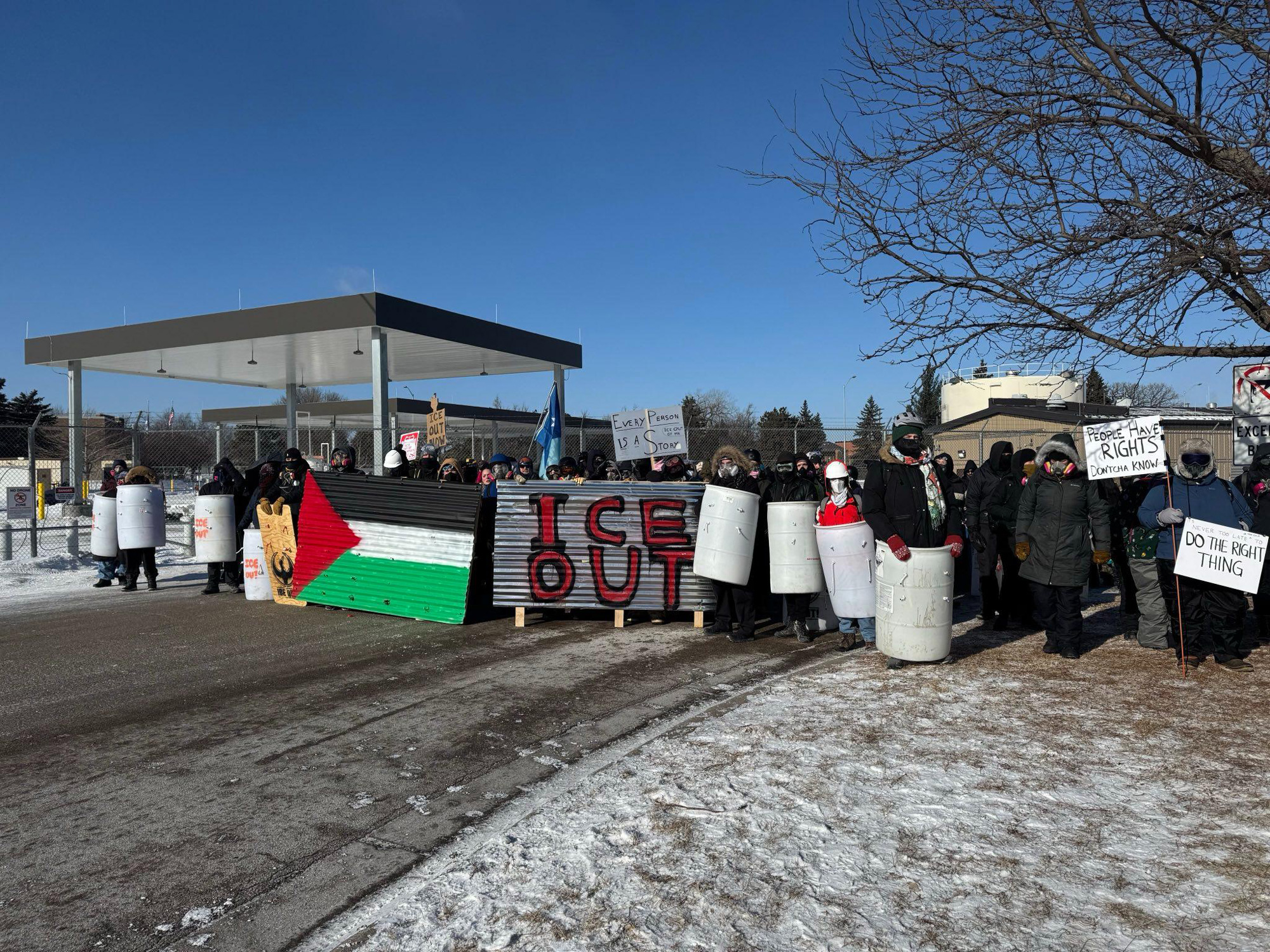
On January 23, thousands of people went on strike in the Twin Cities to oppose the ongoing campaign of kidnapping and murder that federal mercenaries have perpetrated over the past two months in service to Donald Trump’s program of ethnic cleansing. Over 1000 businesses shut down—some enthusiastically, others involuntarily. At the same time, a smaller number of demonstrators set out to prevent federal mercenaries associated with Immigration and Customs Enforcement from carrying out the abductions they had planned for the day.
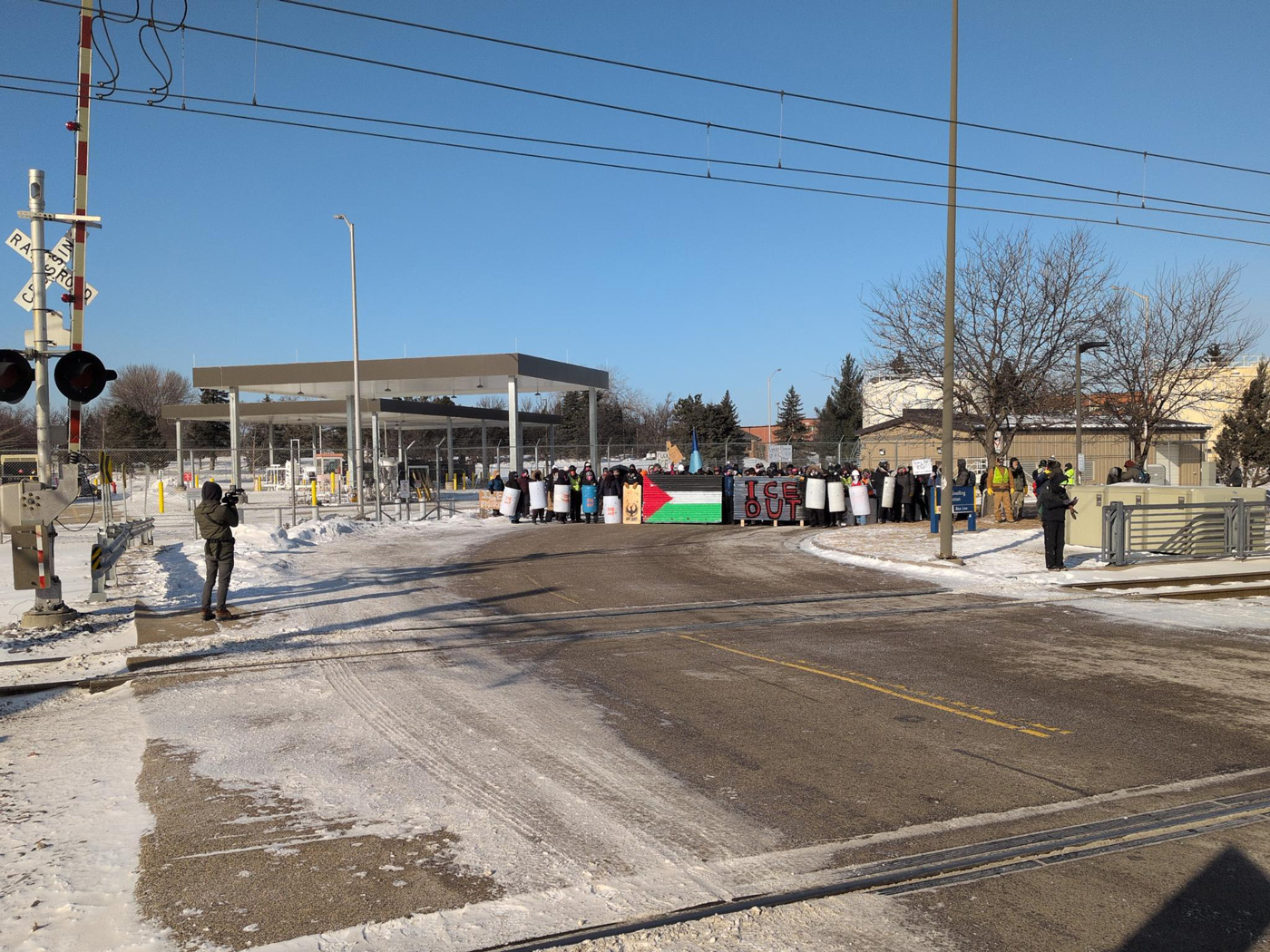
Early on the morning of January 23, in sub-zero conditions, roughly 75 demonstrators with shields and reinforced banners blocked the intersection of Minnehaha and Federal Drive, immediately adjacent to the Bishop Henry Whipple building, which ICE has been using as their base of operations in the Twin Cities. At the same time, someone left an RV trailer blocking Airport Service Road near the north end of Federal Drive (see map). This completely blocked two of the three means of ingress and egress to and from the Whipple building. Presumably, the blockade was intended to box ICE in at the north end of Federal Drive, blocking off every point of egress, but as it played out, they still had access to one exit.
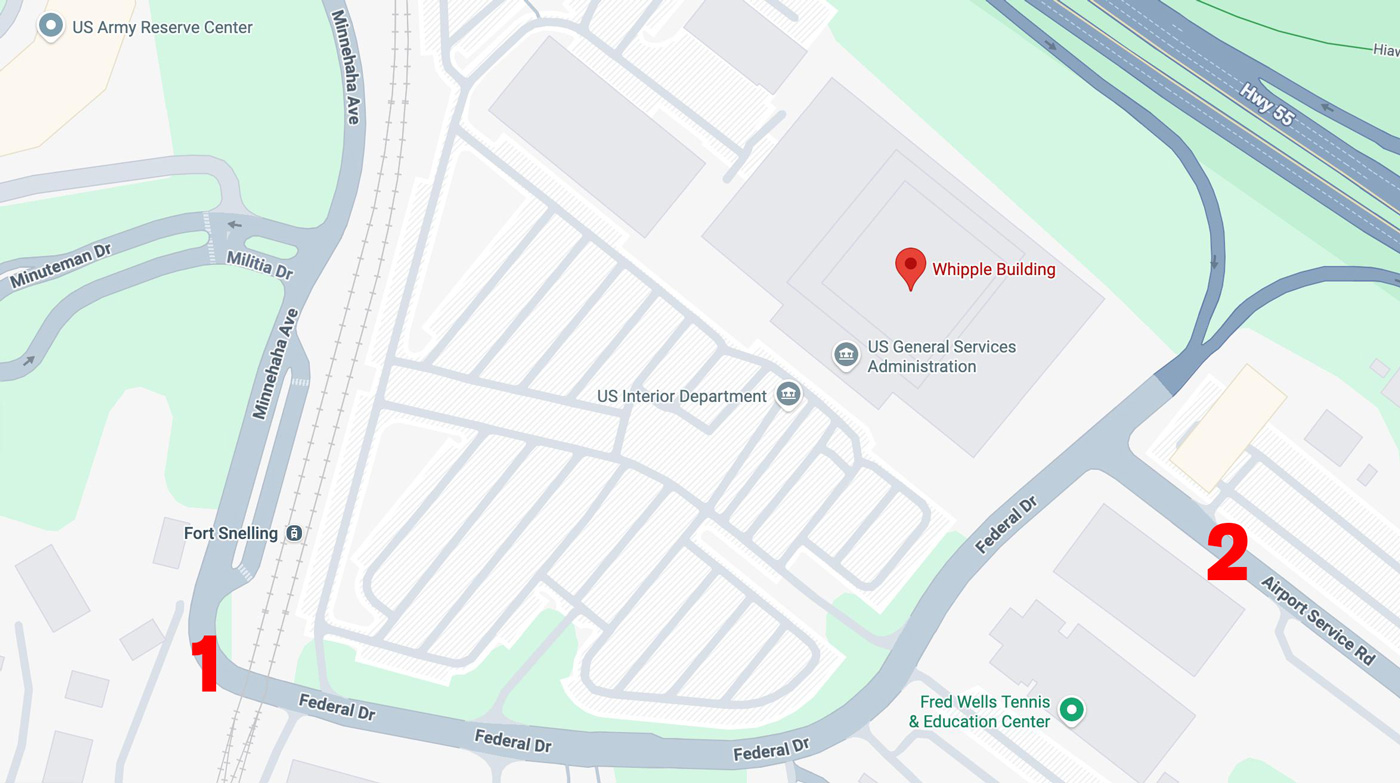
The RV trailer blocking Airport Service Road remained in place for about half an hour. The demonstrators blocked the intersection of Minnehaha and Federal Drive for two and a half hours.
There was no sign of ICE or BorTac (the Border Patrol Tactical Unit, members of which have beaten and tear gassed protesters at prior actions by the Whipple building) during the entire two and a half hours. The ICE motor pool appeared almost totally full during the action, suggesting that they weren’t staging from any secondary location. It is possible that this action effectively trapped a large number of ICE agents at their headquarters.
Eventually, after the trailer had been removed, Hennepin sheriffs threatened to attack the demonstrators with chemical weapons. The participants in the blockade dispersed five minutes later, before chemical weapons were deployed. Two arrests were reported in the area, apparently not in connection with the blockade at the intersection of Minnehaha and Federal Drive.
The role of the sheriffs is noteworthy. From Chicago to the Twin Cities, local and state police that supposedly answer to Democrat politicians have played a fundamental role in violently suppressing protests in order to enable ICE to continue kidnapping and brutalizing people. Any movement against ICE will have to contend with this bipartisanship.
Two weeks ago, on January 8, protesters blocked the gates of the Whipple building for one hour in response to the murder of Renee Nicole Good by federal agent Jonathan Ross. Today’s attempt raises the bar. It is inspiring that thousands of people participated in today’s general strike. The blockade at the Whipple building shows that some are prepared to go further, taking bold and creative action to directly impact what ICE can and cannot do.
In the following anonymously submitted account, participants describe what they witnessed during the blockade and offer some context for their experiences resisting the ICE occupation.
Three Forms of Conflict
“It’s been the longest year of my life.” You can hear this refrain throughout the Twin Cities—and it’s only January. More than fifty days of occupation by federal forces has weighed upon the resolve and well-being of resisters and occupiers alike.
The federal site at Fort Snelling, where the Whipple Building is located, is known for having served as a concentration camp imprisoning the Dakota people in the 1860s. This legacy continues today with the use of the site as the home base for thousands of masked kidnappers. The 3000 federal agents involved in this operation outnumber the ten largest police forces in the Twin Cities combined.
The first abductions began as a trickle and built to a stream, then a flood like the mighty Mississippi. The most henious and evil acts are burned into our brains, reminiscent of the sort of attacks the Israeli army has carried out in the West Bank: ambushes on schools and hospitals, masked invaders using terrified children as hostages, shootings, even a public execution. The piercing tones of 3D-printed whistles are scorched onto our eardrums like tinnitus. Yet the violence of ICE has fueled a shared rage that many people never knew they were capable of. Many new resisters are waking up to this reality for the first time. Others have experienced wave after wave of struggle in the Twin Cities, which have prepared many of us for this moment.
Fascism is not on the way. It is here.
In response, people prepared to go on the offensive on the day of the general strike. This offensive involved three different struggles, none any less important than the others.
Confronting the Self
Like many on the global stage, we find ourselves in unfamiliar waters. The old rules have been thrown out the window. In the streets, ICE acts more like Nazis than like cops. This is especially apparent to those of us with experience in anti-fascist organizing. Their terroristic tactics combine a mixture of brutality and cowardice; their unpredictable nature has strained even seasoned veterans.
This is the first form of conflict we must deal with: struggle against self.
Uncertainty breeds fear. We have use threat modeling to identify what the risks are and which ones we are prepared to run. Movement tactics like positioning sharpshooters on roofs, using security checkpoints, and sending security teams to escort people through dangerous areas have become common once again, as they were in the height of the 2020 uprisings. This is the case even for large meetings now. We study and practice these skills over and over, doing our best to address our fears while seeking to assuage anguish over those who have already been disappeared.
Care must be taken when deliberating too, as frustration can easily flare up over minor or inconsequential issues. Recognizing and regulating our own emotional states is key to avoiding the tendency to act on fear. Group visualization techniques present an opportunity to imagine possible outcomes and prepare our responses in advance.
The crime against humanity that we call genocide doesn’t just affect those who are abducted or killed. Those who remain must carry its weight. In the week leading up to the general strike, we wrestled with all of these things. Nonetheless, we pressed on.
Confronting the Natural World
There is a difference between ordinary cold and bitter cold. It’s difficult to describe if you haven’t experienced it. In the bitter cold, there is almost a serene stillness to the air, a seeming tranquility daring you to underestimate its lethality. Literal arctic chills can spread through our state. A week ahead of the general strike, it became clear that it was going to be a very cold day.
This second form of conflict is just as dangerous as any human violence: struggle against nature.
I’ve seen one exposure death before. The glassy black skin on their body isn’t a vision I will ever forget. ICE have recently been taking a page out of the Saskatoon Police force’s “Starlight Tours” and dropping off arrestees in the middle of the night in remote areas, intentionally using weather exposure as a weapon of torture. On the morning of the general strike, temperature adjusted for wind chill was about -30 degrees Fahrenheit (-35 Celsius). This can cause uncovered skin to develop frostbite within twenty minutes, a challenge that requires careful planning and specialized clothing to address.
In the modern surveillance state, one must also take care to avoid being identified by one’s specialized winter clothing. Despite organized warming stations, several volunteers from out of town underestimated the risks and were injured from exposure alone. There surely would have been two or three times as many participants in the blockade were it not so bitter outside.
As in the fight against the Dakota Access Pipeline, there were concerns that state or federal forces might use water as a weapon. At one point, a scout identifed and radioed out what appeared to be preparations to employ a water cannon. In this weather, with no nearby facilities to warm up in, such a weapon could inflict permanent harm. Similarly, water to flush chemical weapons can pose a risk in these temperatures.
Tensions were high, but with extra jackets and handwarmers, we were able to hold the line.
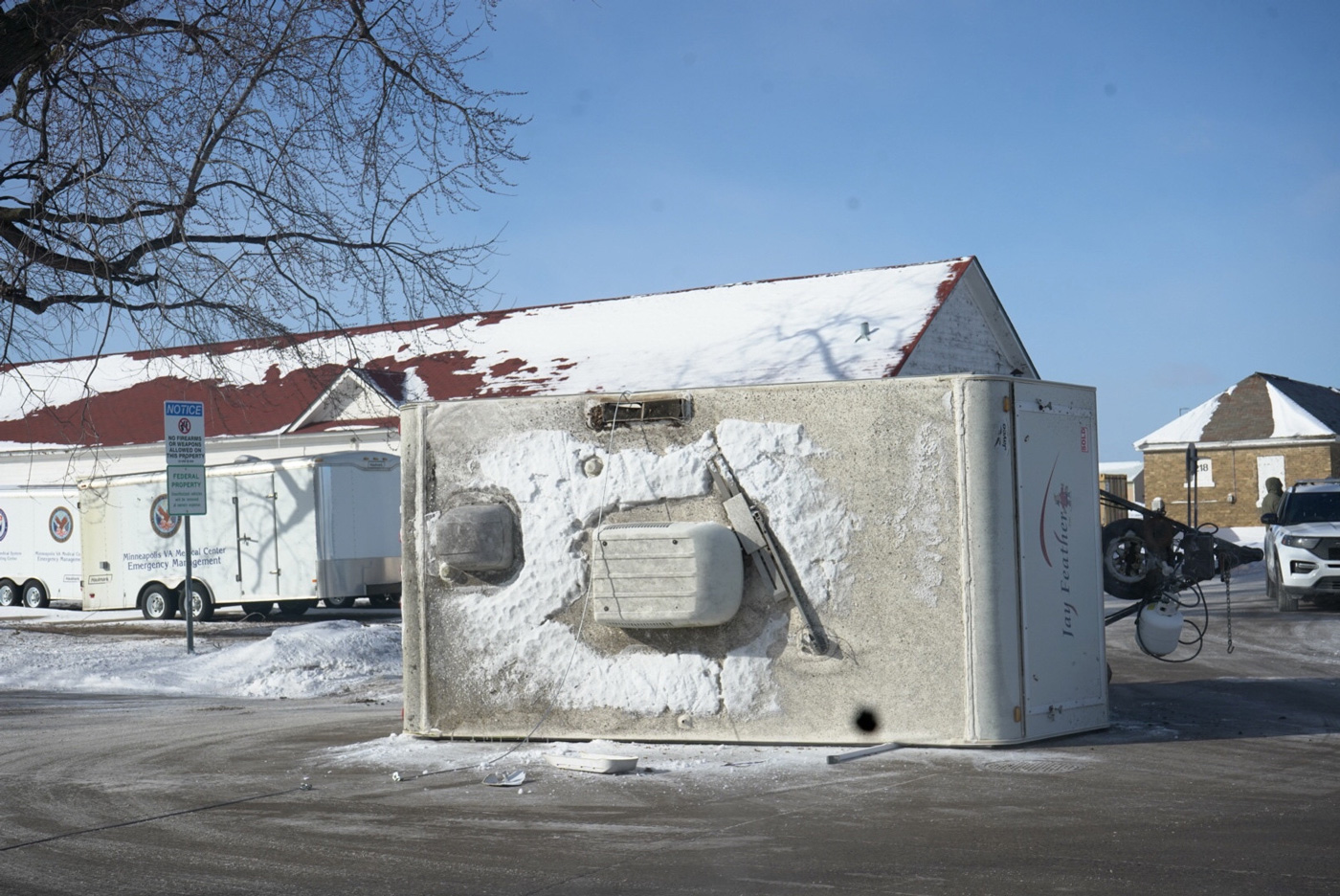
The RV trailor abandoned in the middle of Airport Service Road.
Confronting the Occupiers
Being across the highway from the rest of the city, the Whipple Building is difficult to reach on foot and well-protected from pedestrians. Two days before the action, our adversaries added additional layers of fencing to create chokepoints and opportunites to trap demonstrators. They put up jersey barriers and fences on either side of Federal Drive, all the way down, separating the street from the sidewalk, blocking off every driveway—creating a sort of tunnel. Understood solely as a defensive tactic, this made sense in a mindset obsessed with violence. Though it also made it easier to blockade the route, as their fortifications left them only three exit points.
Four different groups prepared to take action to blockade those points. This is the final form of conflict we must confront: struggle against the occupiers.
One group walked in from the city and train station, carrying shields, steel banners, and other items. Their goal was to block the primary access point, diverting traffic. Arriving early, I saw items being distributed as people huddled for warmth in the exposed parking lot. At first, the numbers looked concerningly small. The group pressed forward to the chokepoint, occupying the area before the tunnel. The demonstrators could not get in, but the mercenaries would not get out.
Perhaps the latter had not prepared for this mutual achievement of goals. In any case, the only forces that these demonstrators encountered were three squad cars from the Hennepin County Sheriff’s Department. The federal forces remained holed up in the building, apparently afraid to step into the cold. The demonstrators chanted and taunted them to draw their ire; still, federal agents did not show themselves. They took no offensive action of any kind.
Perhaps the federal agents, too, are exhausted from their long campaign of contemptible violence. Perhaps they were stretched thin from preparing to deal with the general strike. Perhaps they were more afraid of nature than the demonstrators were. Or perhaps they were obeying strict orders from their commanding officers not to engage, for reasons we can only speculate about.
In any case, it was unusual that they did not attack the blockade. The participants successfully retained all the equipment and supplies they had brought out to the action, which is unusual for such confrontations.
While that group held the city entrance, other groups took coordinated action elsewhere. One group towed blockading material into the highway entrance. The first convoy in this group apparently deployed an RV trailer and exited the area. A second convoy in the group left the area without deploying any sort of barricade, as sheriffs swarmed the trailer at the last second. The single RV trailer that remained nonetheless obstructed egress for nearly half an hour.
Finally, two other groups provided support and a human blockade on a side road. Unfortunately, sheriffs carried out two arrests there during an agressive push towards the fortified “tunnel.” Reportedly, snowballs were thrown at federal vehicles, shattering one window. Ice versus ICE.
After tear gas was deployed, many of the people in this area began coming over to the primary blockade, reinforcing the numbers at the intersection of Minnehaha and Federal Drive.
As the hard barricades were cleared and others poured in, the demonstrators took a moment to consider the situation. They had already achieved their objectives for the day, coordinating between several groups and seizing the opportunity of the general strike as a whole to grind things to a halt at the Whipple building. Given the opportunity to leave without sustaining losses, they chose to take it, leaving before weapons were deployed. They marched back as a single unit in a tactical retreat, still protected by shields and steel banners, chanting “Minnesota’s got the ICE melt!”
For two and a half hours, demonstrators had blocked all but one of the routes in and out of the Whipple building.
Today’s action only strengthens our resolve. Now we have more experience coordinating with one another and more knowledge of the terrain. The fact that federal forces did not show themselves reinforces the notion that they are not prepared to defend themselves in large confrontations—or at least, that they consider it preferable to avoid doing so. Their continued reliance on state police and sheriffs poses complicated strategic questions for us, but it could also create complications for them in the future.
As local comrades recently stated in regards to Donald Trump’s threat to invoke the Insurrection Act:
“We must continue to organize communities, patrol our streets and build rapid response teams, push for workplace stoppages, and grind them down every step of the way. We must exact a price for every footprint they leave in our snow. When we have the opportunity, we will drive them from our streets and tear down their concentration camp. ICE will melt when the heat turns up.”
Forever yours in struggle.
Further Reading
- The Noise Demonstrations Keeping ICE Agents Awake at Their Hotels: A Model from the Twin Cities
- Minneapolis Responds to the Murder of Alex Pretti: An Eyewitness Account
- From Rapid Response to Revolutionary Social Change: The Potential of the Rapid Response Networks
- Rapid Response Networks in the Twin Cities: A Guide to an Updated Model
- North Minneapolis Chases Out ICE: A Firsthand Account of the Response to Another ICE Shooting
- Minneapolis Responds to ICE Committing Murder: An Account from the Streets
- Protesters Clash with ICE Agents Again in the Twin Cities: A Firsthand Report
- Minneapolis to Feds: “Get the Fuck Out”: How People in the Twin Cities Responded to a Federal Raid