Steal Something from Work Day 2026
:Why Nurses Steal to Save Lives


For many years, we have joined others around the world in observing April 15 as worldwide Steal Something from Work Day. Last year, we prophesied that the arrival of a new cast of kleptocrats at the head of the federal government of the United States would only intensify the factors that give rise to workplace theft. In fact, the first fifteen months of the second Trump administration have seen workers around the country rapidly radicalizing and escalating their efforts to counter the ongoing plunder of our society. In 2026, when Large Language Models are pillaging the intellectual heritage of humanity in order to steal everyone’s jobs while underpaid workers are burning down warehouses and carrying out direct attacks on employers, Steal Something from Work Day is the moderate option.
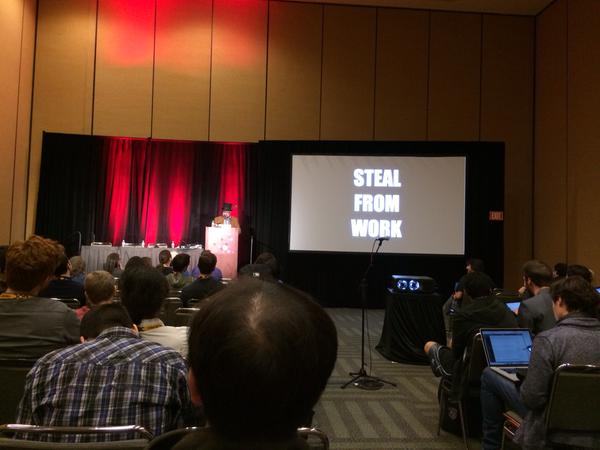
Jason Scott of Internet Archive speaking at the 2015 Game Developers Conference. “Steal from work,” he advised a crowd of game industry professionals. “Workplace theft is the future of game history.”
This year, we present two accounts from nurses who steal for the common good. In honor of the fight that people in the Twin Cities have put up against the Immigrations and Customs Enforcement occupation of their communities, we share testimony from a nurse in Minnesota who reappropriates medical supplies from the workplace to equip those who are confronting ICE in the street.
To learn more about other ways that nurses have helped to rescue people from the clutches of ICE, you could read this.
I. “When I’m good, I’m very, very good, but when I’m bad, I’m better”
Everyone assumes that nurses are “good.” We get treated like God’s little soldiers. Nurses often feel a sense of moral high ground. People who aren’t nurses adopt this tone when they are talking about us, too.
This shouldn’t be the point. Often, people who see themselves as “good” do a great deal of harm in the world, while people who are behaving badly actually help people. No one should be so focused on proving that they are “good” that they miss a chance to help someone.
There are four general categories of workplace theft at the hospital:
- Medical supplies for community support—for example, snatching a box of speculums so people can learn how to do self-exams.
- Household items—batteries, toothpaste and brushes, toilet paper, wipes, and the like.
- Worker solidarity—for example, taking meds out of the Pyxis when your coworker has a headache or cramps. Likewise, covering for your coworker so they can get a nap during night shift. Nurses provide better care to patients when they are properly rested and not in pain! You can also clock each other in or out, late or early, depending on the situation.
- Finally, stealing to help your patients: not scanning meds when you don’t need to, not entering patient ID codes when getting them things from the Omnicell, ordering extra food for visiting family members, sending patients home with extra supplies.
If you’re a patient in a hospital and a nurse is caring for you, chances are, some element of the care they are providing you is reaching you in defiance of the system that exists to exploit both nurses and patients. When it comes to being good, don’t be afraid to be bad.
II. Steal from Work to Support Community Defense
When Metro Surge came to Minneapolis, it felt like a hammer falling—a hammer that had been hanging over us since election day. As January got underway, we could feel the pressure rising in the administration’s increasingly violent rhetoric—while the temperature continued to drop, setting the stage for one of the coldest and snowiest winters in recent memory. Still, none of us anticipated what was to come just a few days after the new year.
In response to the murders of Renee Good and Alex Pretti, who was also a nurse, so many of us felt compelled to do something. This is one of the stories about what people did.
Why nurses feel no moral contradiction when liberating resources from the workplace
If you were to ask me why I became I nurse, I would say because I want to help people. I know what it’s like to be in pain, to feel that nobody is around to help you, that all of your time and resources are going to something you cannot control, all while watching the oligarchic government and hospital CEOs slowly chip away at your life savings.
On average, big hospital chain systems pay their CEOs between one and seven million dollars a year—while nurses are doing the real work at the bedside, risking our lives for a barely living wage. (Don’t get me started on the insurance CEOs who make between $20-30 million a year.) Manufacturing a one-liter bag of normal saline costs two dollars on average. Yet hospitals on occupied Turtle Island sell the bags at upwards of $700. Individuals who need to stay in the hospital incur costs for the room, with nursing staff and doctors adding another $2600 to $3000 a day to this cost.
As of 2023, some 80% of the nursing workforce reported workplace violence impacting their ability to do their job. Does nobody see the correlation between this violence, the widening wealth gap, our patients’ inability to afford the care they need to survive, and the ever-growing greed of the few who want everything all to themselves? There are no beds to spare at the hospital and patients sleep in the hallways and ambulance bay, yet both rural and inner-city hospitals continue to close for lack of resources.
In 2020, the city of Saint Paul closed St. Joes, the oldest hospital in the state of Minnesota. The community lost 253 beds at the beginning of the COVID-19 pandemic, the worst pandemic in modern history. In 2023, Fairview filed to sell the medical complex system that sits on both sides of the Mississippi to Stanford Health, seeking to merge the healthcare companies; if Fairview didn’t get someone to pay them out, they would have to file for bankruptcy. The CEO of Fairview, James Hereford, makes $4.3 million a year, which makes him one of the highest-earning healthcare CEOs in the Midwest. Yet the people who rely on the medical and Medicare system are the ones who are blamed.
The “trickle-down system” is bleeding backwards, against gravity, up the pyramid to the top where the wealthy few are positioned. How can you claim to be a nonprofit company while the people at the top of the pyramid are making several millions of dollars in a year—and then nonetheless claim that the company is unable to stay afloat without a buyout?
How to steal things from work as a nurse (because Alex Pretti would want you to)
- First, focus on things that are easy to fit in your pockets: alcohol swabs, small gauze pads, hemostat dressing, kerlix, bacitracin, band-aids, tape. If it’s easy to liberate those resources, make small medic packs out of what you gather and distribute them to those who are on the front lines, defending your community every day. No one who is taking on that responsibility should have to pay for these items. Requisitioning these items can save funds that can go towards buying medical resources that no one can liberate from a workplace.
- When you find yourself in a stockroom, take what you need to perform care for your patient, then grab a few packets of gauze or some band-aids. You can build up a stock more quickly than you’d think.
- Create reasons to go to your locker in order to empty your pockets. For optics, keep snacks or other items in there, so you don’t return from your locker empty-handed.
- For larger things like boxes of gloves or larger containers of disinfectant wipes, you’ll want to bring a backpack. At some hospitals, it’s not uncommon to see gloves or surface wipes in the staff bathroom or locker room. Once you’re out of view of the camera and the break room is empty, throw the stuff in your bag.
Remember, nobody questions a nurse that looks busy.
Supply liberation and time exploitation should never come before bedside patient care. Ensure that your efforts to hold both identities as a nurse and a comrade don’t conflict with the ethical reasons you chose both sides of this work. Your goal is to decrease harm and pain: you are exploiting an unfair healthcare system while working directly with people who are in pain, many of whom understand that the system is exploiting them, too.
I liberate out of love, I expropriate in the name of harm reduction, I “steal” in the name of all of the people killed by the state of so-called Minnesota. I take in hope that these medical items can help to save or ease the lives of community members, so we don’t have to experience once again the trauma we experienced when we lost Alex, Nicole, Amir Locke, Winston Boogie Smith, Philando Castile, George Floyd, and too many others. Death at the hands of the state is so pervasive and the price of medical supplies is just too damn high.
Ethical ways for nurses to liberate time and knowledge
Time theft is complicated when you’re a nurse. You work for the healthcare company, but you care for the patients; if you forget that and no longer see those you care for as human, you become part of the problem. The healthcare system is not human, and in any case, you will hurt your workplace very little by stealing things. But if you engage in time theft carelessly, you can strain the care that someone else is dependent on you for.
You can take a longer break than your allotted time IF
- no medications are late;
- a nurse on the floor is prepared to answer for you when a patient calls (this is usually a trade: “I’ll look over your patients if you look over mine”);
- there is no loss in patient trust or in the integrity of their care if the primary nurse is gone for an additional 15 minutes.
You can clock out a little late so that you can take the time to care for yourself between caring for patients and not have to rush your charting.
If the hospital pays for your continuing education credits, you can use these to learn things that you can pass on to others in a community setting, such as diabetes education, CPR, and wound care. Rephrase the education you receive as a nurse when you present it as public-health community education: you’re not giving medical advice, but simply explaining how a body process or disease works.
Further Reading
- The View from New Orleans: An Anarchist Nurse on What the Hurricane Means for All of Us
- What Can Anarchism Do for Nursing?