Anarchists at the 2026 No Kings Rallies
:Reports from around the Country

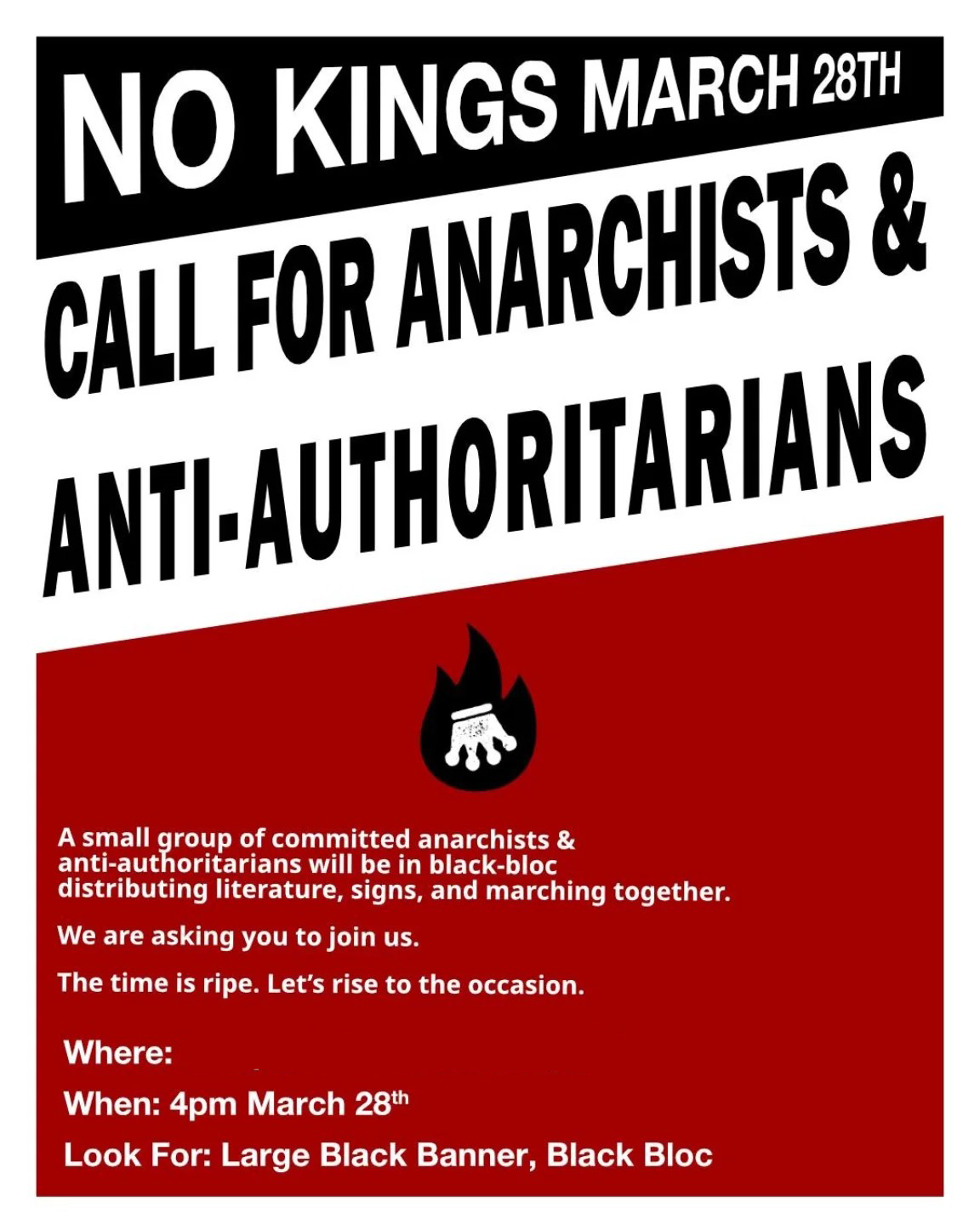
Ahead of the third No Kings worldwide day of protest on March 28, we published a call for anarchists to engage with the rallies as an opportunity to draw people into more concrete forms of organizing and action, and offered handouts for that purpose. Here, we share highlights and reports from some of the participants in the day’s events.
Organizers claim that a total of eight million participants in the protests, up roughly a million from the October 18 No Kings rallies, which we had also published a call to engage with. Donald Trump’s popularity has reached an all-time low, as he continues to an unpopular war with Iran after his attempt to use Immigration and Customs Enforcement to terrorize cities like Minneapolis was thwarted by grassroots resistance. Yet concrete mass resistance has yet to take shape in most of the country.
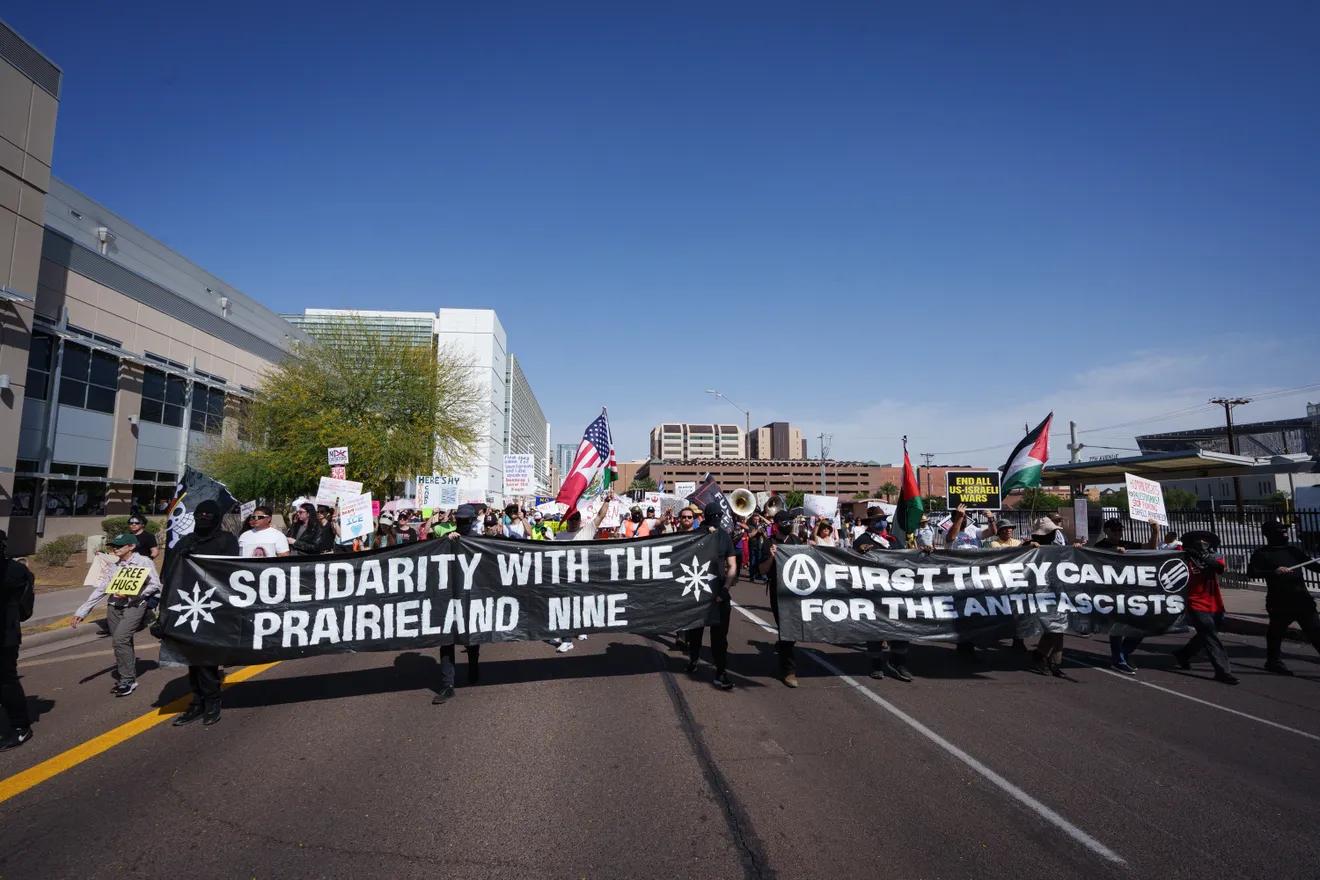
This makes anarchists’ efforts to demonstrate a way forward especially important. In Phoenix, in response to a local call for an anarchist contingent in No Kings expressing opposition to borders, ICE, and repression, anarchists displaying banners reading “Solidarity with the Prairieland Nine” and “First they came for the anti-fascists” marched at the very front of the crowd.
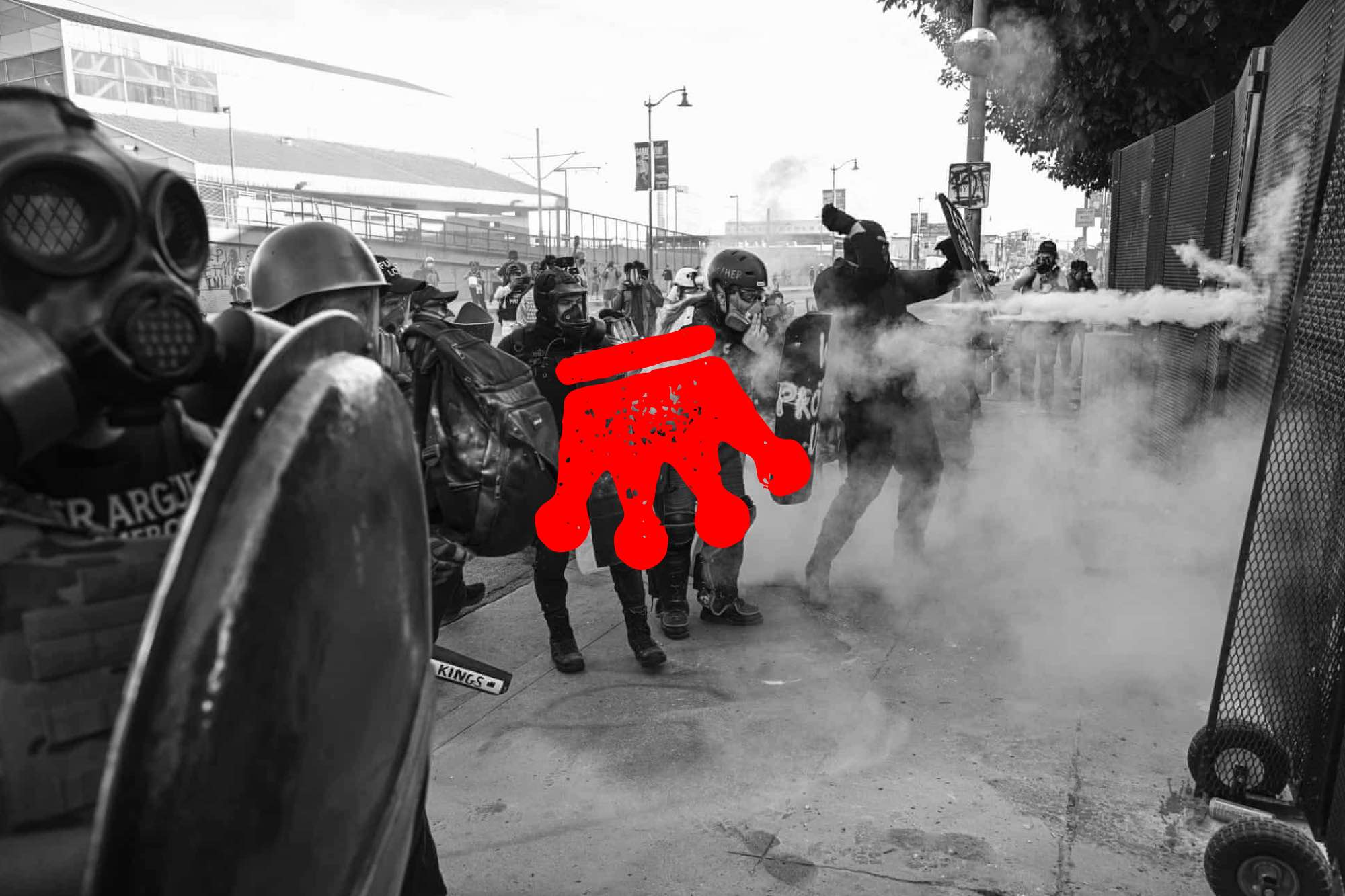
Many of the flashpoints of March 28 took place at locations that have already become battlegrounds under the Trump administration. In downtown Los Angeles, protesters hurled chunks of concrete at Department of Homeland Security mercenaries outside the same federal detention center that was at the center of the clashes that touched off the uprising against ICE in June 2025. At the ICE facility in Broadview, near Chicago, Illinois, police arrested and brutalized several protesters. In Denver, protesters took over highway I-25, forcing police to respond with tear gas.
In addition to the reports below, you can consult this report-back from anarchists in central Oregon.
cdn.crimethinc.com/assets/articles/2026/03/31/4.jpg
Dallas/Fort Worth, Texas
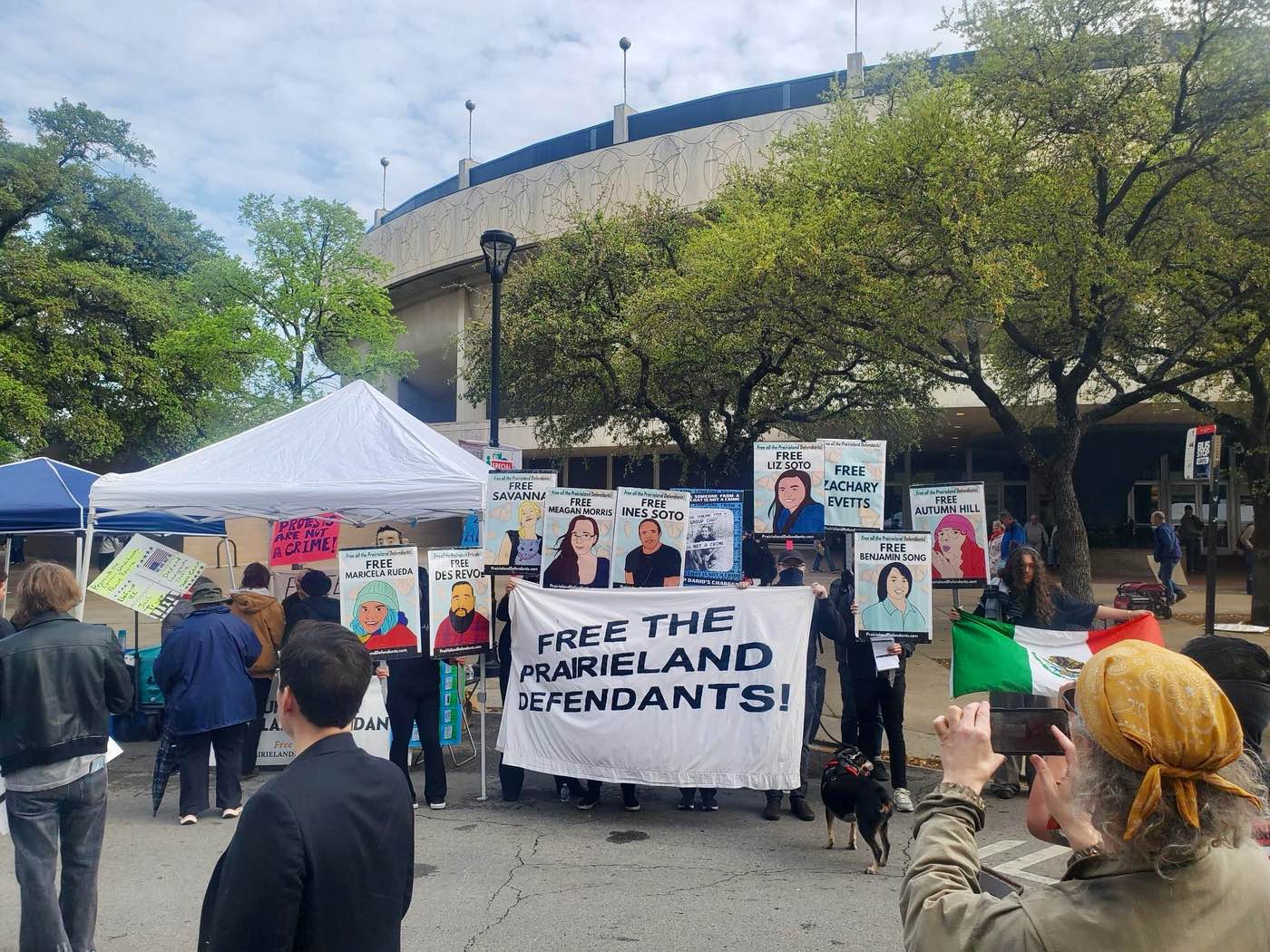
Supporters of the Prairieland defendants attended three No Kings events in DFW this past weekend. We passed out hundreds of fliers and had lots of conversations about the case, with both random attendees and activists. It was a great opportunity to see how far awareness of the case has spread—and it does seem to have spread.
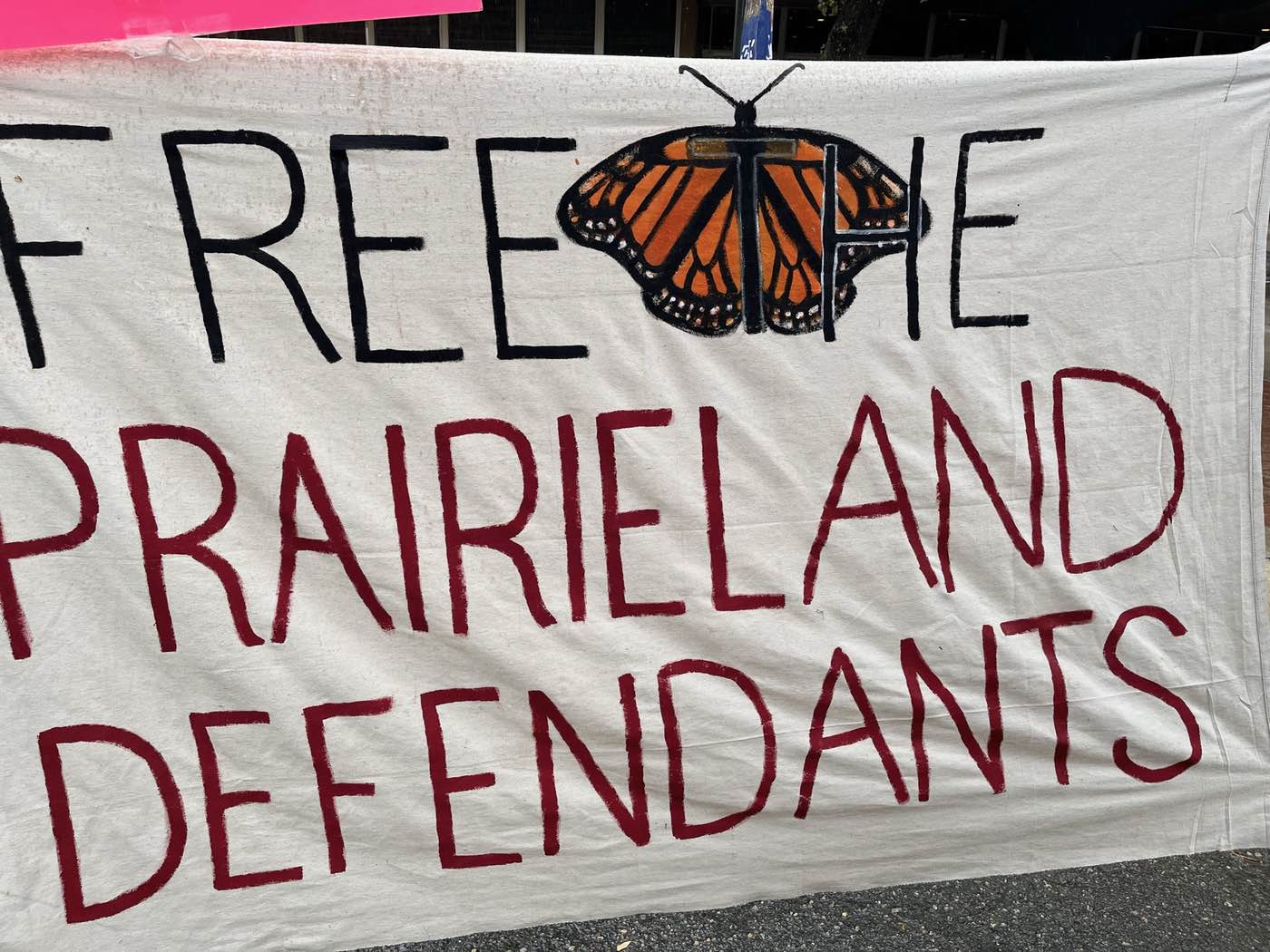
In Fort Worth, members of the DFW Support Committee had an official table and a speaking slot. We marched together, including two random young people who felt inspired to join our crew, with the defendant signs and a large banners that read “Free the Prairieland Defendants.”
cdn.crimethinc.com/assets/articles/2026/03/31/2.jpg
cdn.crimethinc.com/assets/articles/2026/03/31/3.jpg
Modesto, California
In Modesto, anarchists set up a free zine table with CrimethInc. stickers and color posters at the recent No Kings rally. The rally brought out hundreds of participants. We handed out free zines about the anti-ICE struggle and rapid response networks along with information about protest safety and more. Someone from a local group brought over a big bag of homemade whistle packs they had made at a recent event, featuring the number for the local rapid response line.
While thousands of miles away, the struggle in Minneapolis has had ripple effects here, pushing many to embrace the fight against ICE and get involved in local autonomous efforts. Many speakers at the event encouraged participants to get involved in anti-ICE organizing and to support calls for a general strike on May 1st—efforts we can all amplify and build toward.
cdn.crimethinc.com/assets/articles/2026/03/31/19.jpg
New York City, New York
We printed 800 flyers. Our little team distributed something like 700 of them in about two hours.
We found ourselves circulating alongside the usual suspects selling socialist newspapers, but had positive response rates probably over 80%, with most of us remarking that sustained one-on-one conversations were a personal highlight. X—— and I talked to one older white woman living in Harlem who was giving out quarter sheet flyers that just explained how to download Signal. Lit.
I’m starting to feel that “liberal” (a coherent historical and political position advocating for free trade and political rights for citizens) is a poor descriptor of this kind of crowd. The widespread affect was both anger and directionlessness. X—— remarked that it would have been easy and politically striking to enter the crowd with huge banners on sticks or flags saying FREE THE PRAIRIELAND DEFENDANTS. The march offered physical and political space for that kind of heterogeneous vibe; an avant-garde contingent could have made use of it.
It would have been moving to me to do something like that. It probably been useful for creating a pole to flyer and start conversations around, assuming we had a concrete project to involve people in.
A College Town
We live in a college town of less than 100,000 people. We published an open call for an anarchist contingent in the No Kings demonstration here.
The demonstration was to begin downtown, then march through the business district to a rally a half hour’s walk away. We knew it would be very difficult to find each other in the crowd, so we chose a convergence point several blocks away, at a location that has often served as a gathering point for previous anarchist demonstrations.
As it turned out, however, some of us met there and proceeded to the main starting point together; others showed up at the starting point of the main demonstration, and indeed became lost in the crowd; and still others went directly to the site of the rally to set up literature tables, as they had done at the previous two No Kings demonstrations.
Once those of us who met at the convergence point reached the crowd—which consisted of many thousands of people—we began distributing stickers and handbills promoting anarchism and an upcoming date on the Breaking the ICE speaking tour that was booked nearby. We gave out several hundred of these, but the march got underway before we could find each other again, so we marched in smaller knots, carrying our banners separately rather than in a single bloc. In the end, it may not have made much of a difference—almost everyone on the streets was in the march, so there was no crowd of spectators to witness a coherent anarchist contingent.
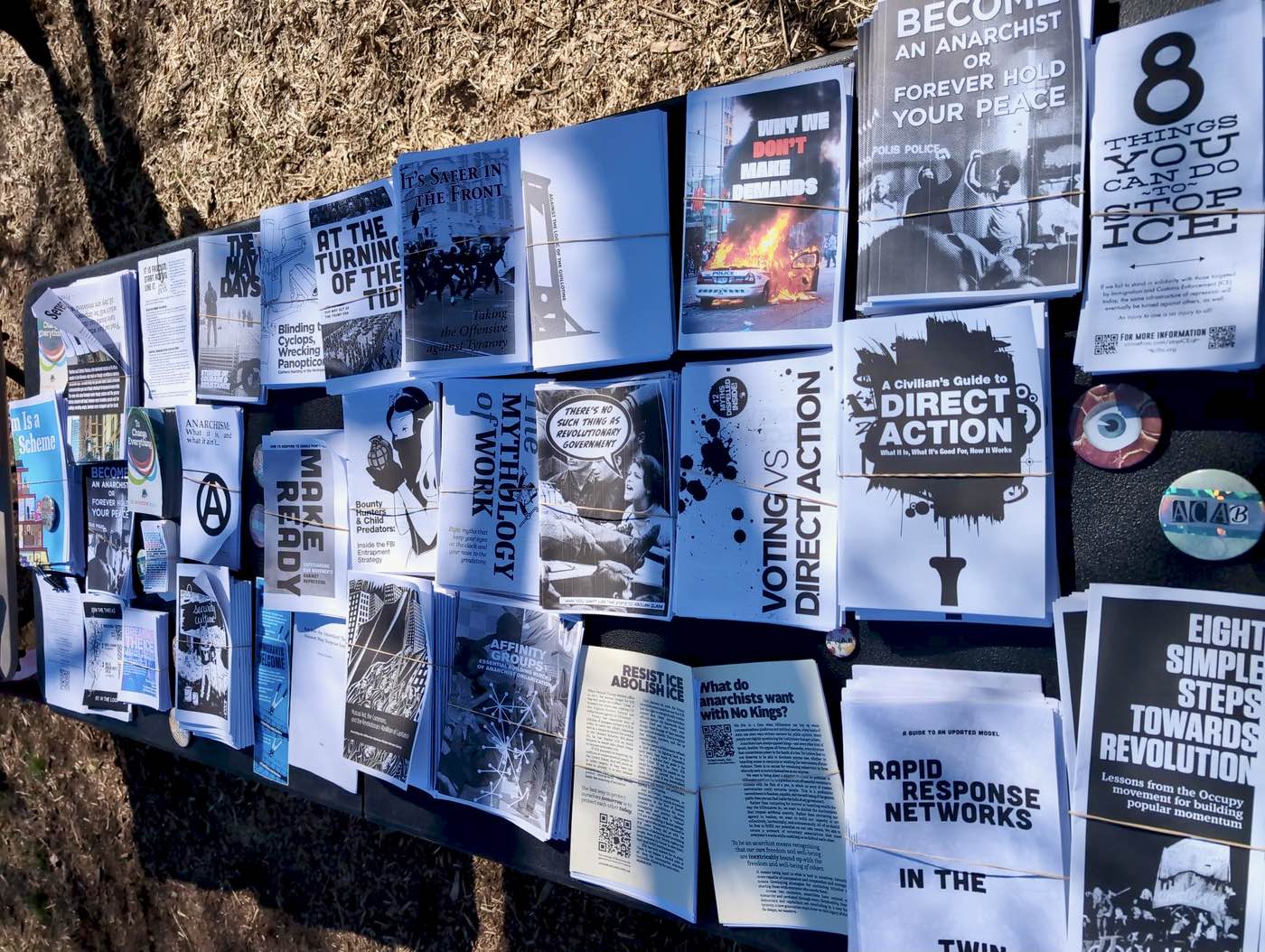
When the march reached the rally, it was easier to find each other around the folding tables that our comrades had set up and covered with zines. Throughout the rally, people came up to the tables; this turned out to be the part of the day when we were most identifiable as a political pole within the crowd. One smart tabler put up flyers throughout the rally area encouraging people to download Signal and subscribe to the local announcements-only Signal thread promoting anarchist events in the area.
An anarchist literature table at a No Kings protest on March 28, 2026.
Among ourselves, we took different approaches to engaging with the crowd. I spent the entire time proselytizing for the upcoming speaking event, just trying to get people into the room to learn about direct action. By contrast, one comrade got into a shouting match with a liberal carrying a sign proclaimed “I want to be governed, not looted”—the liberal simply would not understand why an anarchist would prefer to loot and not to be governed.
Although students at the university make up fully a quarter of the population of this town, the majority of the participants in the demonstration were in their forties or older. That underscores the fact that, while many millions of people have participated in the No Kings demonstrations, millions more who oppose Donald Trump—especially from the demographics that were the driving force behind the George Floyd rebellion—have stayed home. So far.
Afterwards, I spoke with anarchists in several mid-sized Midwestern cities whose efforts to engage with No Kings had gone similarly: they had showed up with banners and marched together in small groups, without anything happening that was especially worth reporting on. But they did distribute a lot of handbills, whether about the Prairieland case or other things.
I still think it would be advantageous to be able to show up to these demonstrations in large numbers with black flags and march together in a coherent bloc. If we want people to be interested in participating in anarchist initiatives, we have to show that we are a force to be reckoned with. When the streets are already full of people and the police have their hands full, doing so should be easier and safer than usual.
A banner displayed by an anarchist contingent in a No Kings demonstration on March 28, 2026.
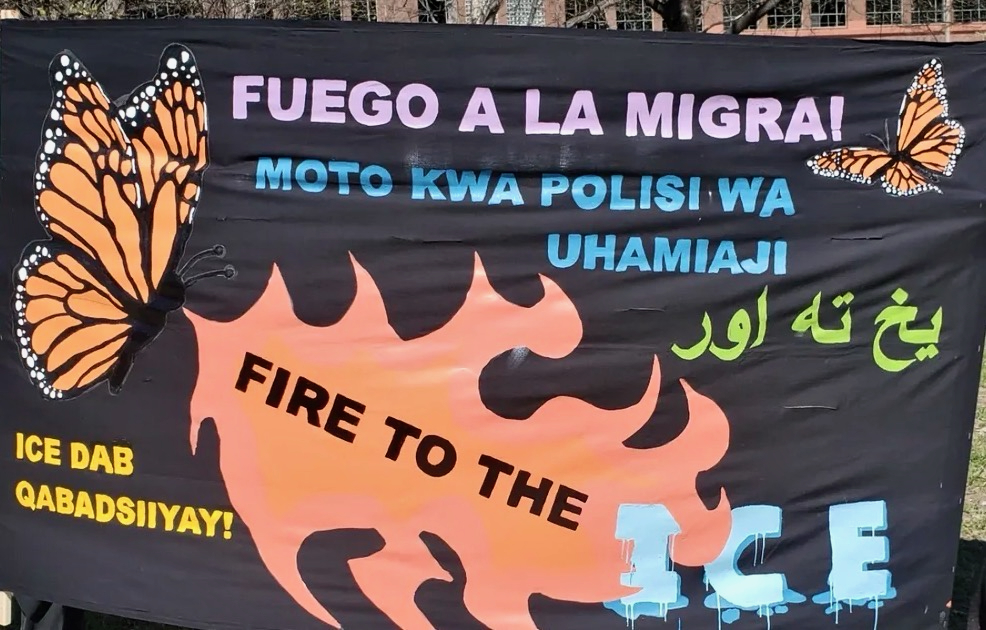
A Mid-Sized City
We live in a mid-sized city, somewhere around 180,000 people. Our previous No Kings events were pretty substantial, and this weekend was no different with maybe 2000 people participating. A medium-sized group of us showed up in full black bloc. Before we even reached the protest, we were heckled by trucks and passersby. Fortunately, we were not the only anarchists there—we immediately found others in bloc that we didn’t even know. Once we combined numbers, we comprised a decent proportion of the protesters present.
We spent much of our time leading chants and dancing to music, while the liberals around us sat in almost dead silence. We also handed out about 100 pamphlets and zines and talked to even more people about what being an anarchist means for us.
Our location in the protest was interesting—we were located on the sidewalk adjacent to a busy intersection, with us at the very end, facing the busiest corner in the area. Many drivers and passersby honked and chanted in support as they passed by. Others were less supportive. One truck dropped burning coal rocks in front of us; it was more pathetic than dangerous.
About 45 minutes in, we saw a crowd developing on the other side of the intersection, wearing MAGA hats and carrying flags and signs of hate. They kept shouting at us from the other side of the street and occasionally throwing things at us. Finally, some of the counter-protesters broke off from their group and walked towards our crowd.
We interpreted this as a threat against the safety of every protester present, but also as an opportunity to show people that we don’t have to tolerate hate.
We moved to the edge of the sidewalk and cut them off, preventing them from getting to the rest of the crowd. We yelled over them and refused to give them the opportunity to speak. When they got right up to us, they began yelling and threatening us, which caught the attention of some protest “marshals.” The marshals demanded that we let them pass and not give them any attention. We acted like we didn’t hear the marshals and continued blocking the counter-protesters off with a massive sign—poetically, it read “Fascists not welcome!”
Eventually, the counter-protesters made their way back to their people. Altogether, they numbered no more than a dozen compared to our nearly 2000.
We believed our presence at no kings was a local success. We spoke to a lot of people sympathetic to anarchism and anarchists. We made many new friends—and some enemies, but we did so unapologetically.
One thing we did that we would like to recommend to anarchists everywhere else—stop bringing your phones to protests and instead bring Meshtastic LoRa devices. We were able to communicate effectively and efficiently without getting pinged by any cell towers. Our presence was basically invisible there, and being able to communicate that way gave us a unique advantage over our local surveillance adversaries.
Portland, Oregon
This video shows the conflict at the ICE facility in Portland on March 28, 2026.
After roughly 30,000 people flooded downtown Portland for the No Kings parade, a few hundred made their way to the ICE facility on the South Waterfront. People chanting “ICE out!” filled the driveway, stepping over the thin blue line that federal agents painted across the entrance to denote the point beyond which they are determined to arrest people.
After someone burned an American flag in the driveway, federal agents surged out and made an arrest. The crowd immediately pushed forward, forcing the agents to retreat back inside. Over a hundred people flooded the driveway. Projectiles flew towards the feds—water bottles, sticks, and random objects. Surprisingly, Department of Homeland Security agents did not respond with munitions.
The vicinity of the ICE facility in Portland, Oregon.
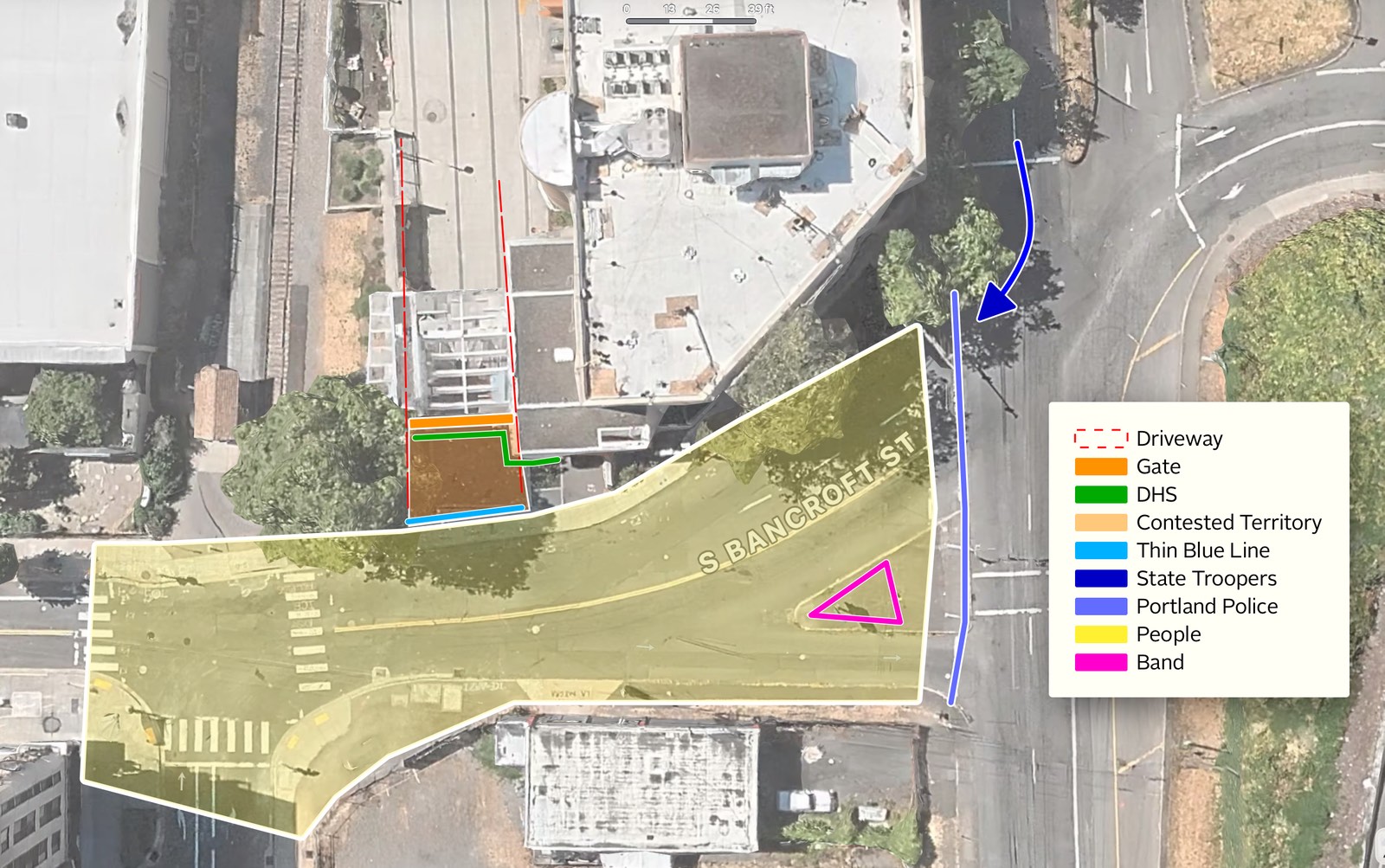
Shortly after 6 pm, a band set up across the street, using a megaphone propped up on a mic stand. By sunset, the crowd had swelled to around 500.
As the band played on, another rhythm took over: the rattle of the facility gates, shaking in time with the drums. Then—suddenly—they gave way. The gates burst open, and a few people stepped through.
DHS took their time responding. No Border Patrol, no Border Patrol Tactical Unit, no familiar wall of federal tactical gear—at least, not at first. For the first time in a long time, the feds in Portland hesitated.
It turned out that they were waiting for backing from the local authorities.
Soon after DHS went back inside, Portland Police bike cops formed a line up the street at the intersection of Bancroft and Macadam. A riot van pulled in behind them and Oregon State Troopers spilled out to join the formation.
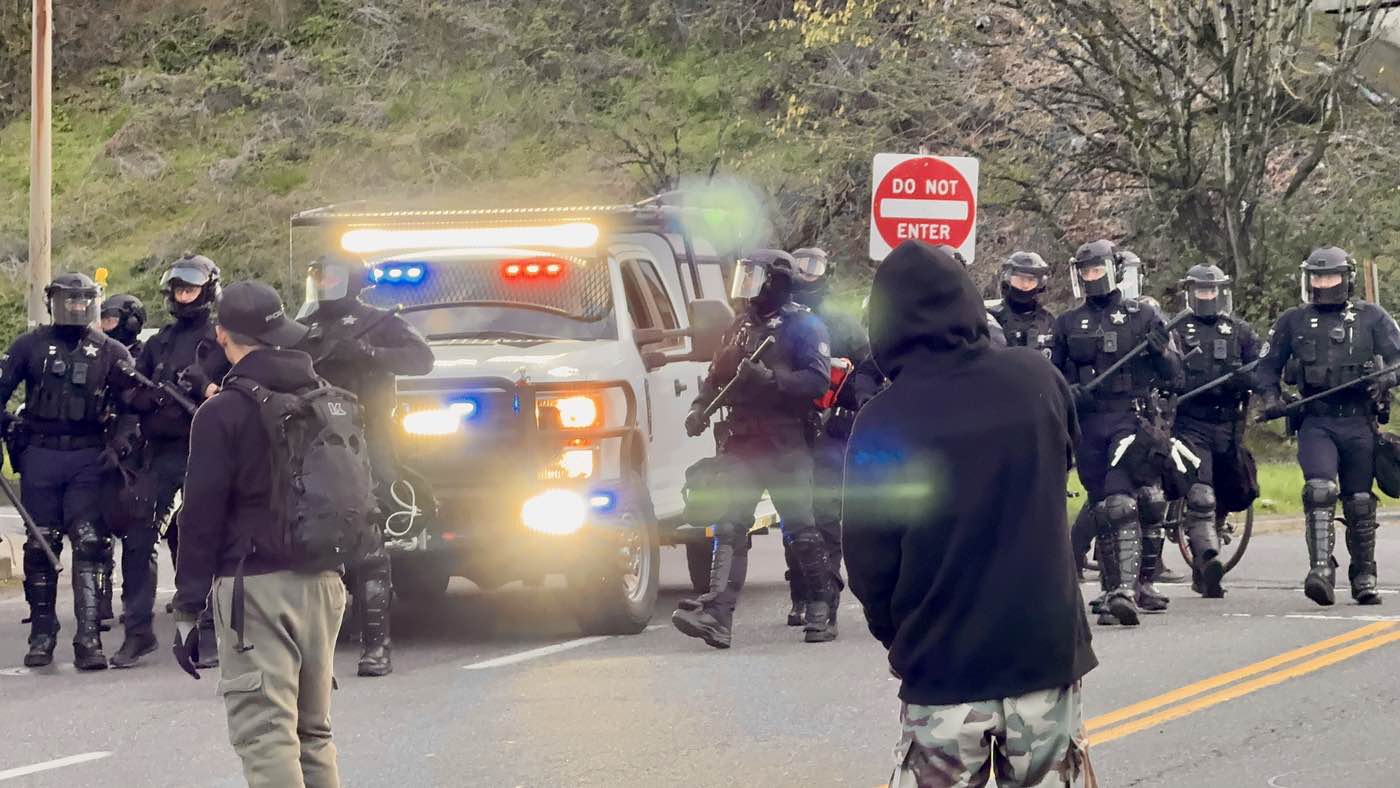
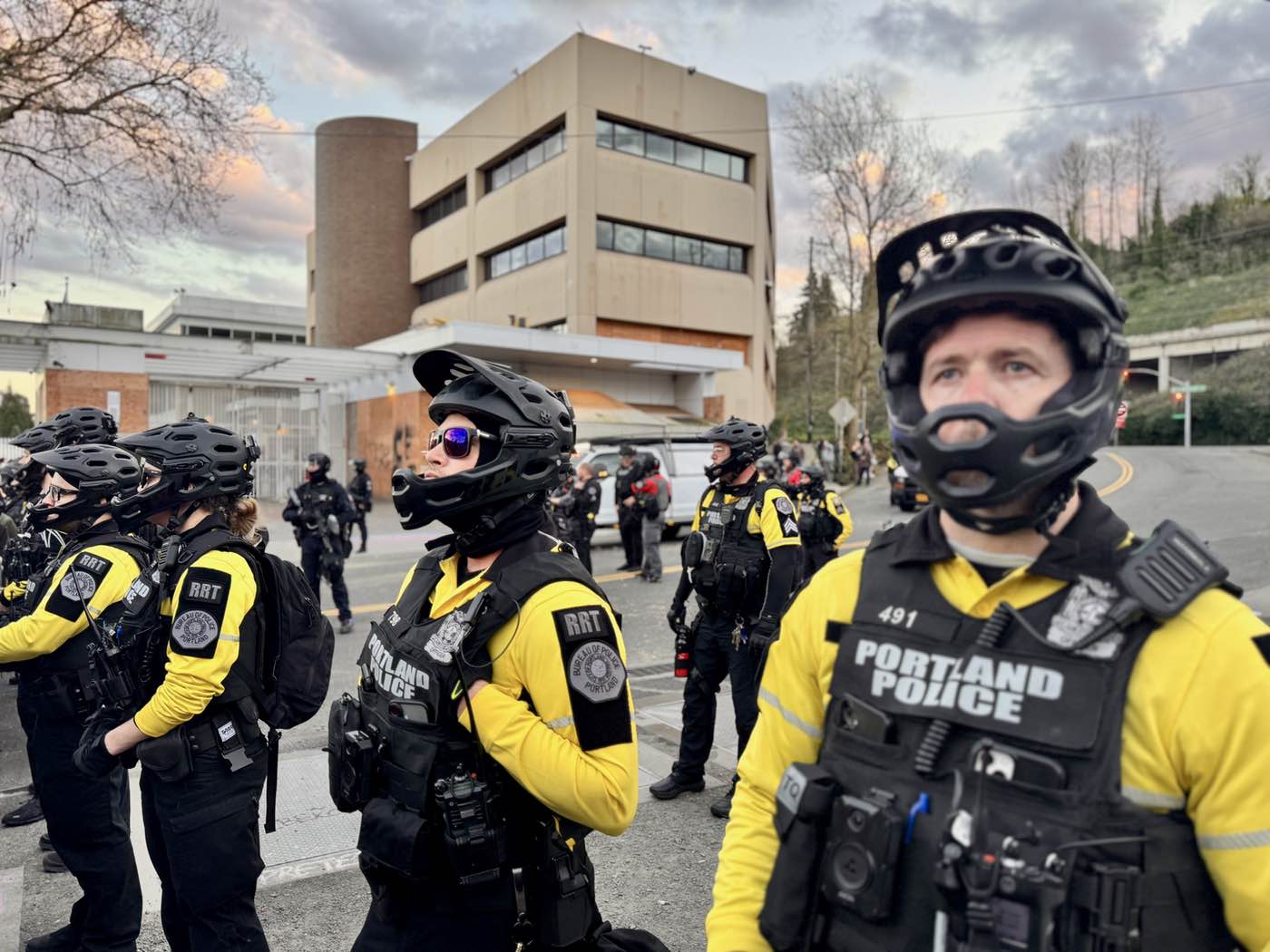
A Portland police officer known for his brutality.
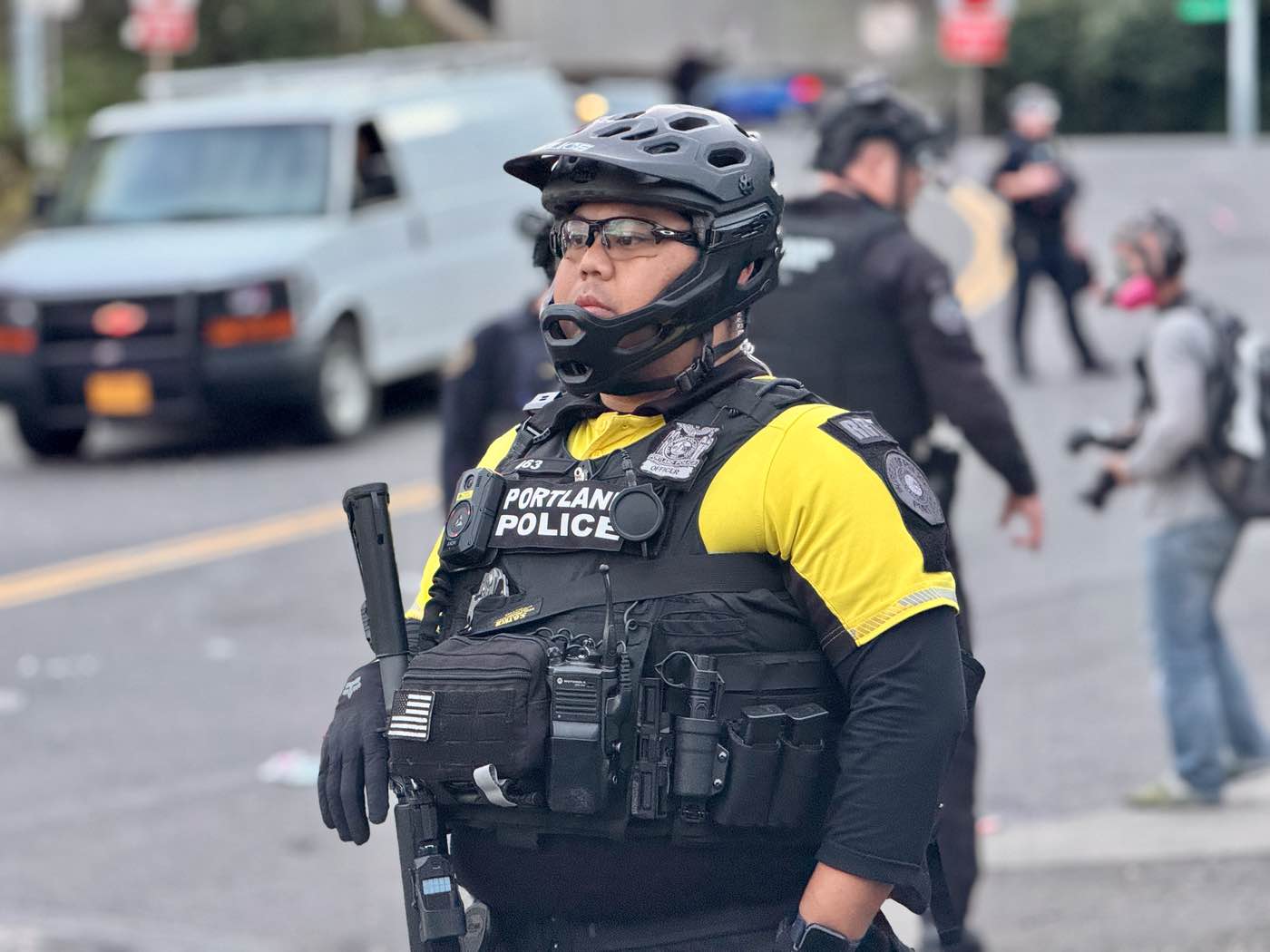
Together, they advanced on the crowd. The push from police was immediate and aggressive—they shoved people to the pavement, knocked older folks out of lawn chairs, barked orders to move back when there was physically nowhere to go. They forced the crowd back until they reached the edge of the facility, then declared the area closed, holding the line while the feds repaired their gate.
Just before 8 pm, nearly an hour later, police pulled back. The gate was fixed and local police had finished doing the feds’ bidding. The crowd erupted: “Whose streets? Our streets!”
The fixed gate didn’t last two minutes.
Hands were back on the gate. Metal groaned. And once again, it broke open. The crowd roared. Graffiti spread across the building: “Kill nazis,” among other tags. Within minutes, DHS returned—this time, with Border Patrol agents in full fatigues and gas masks. They carried out more arrests, bringing the total to at least four.
DHS agents at night, before they retreated.
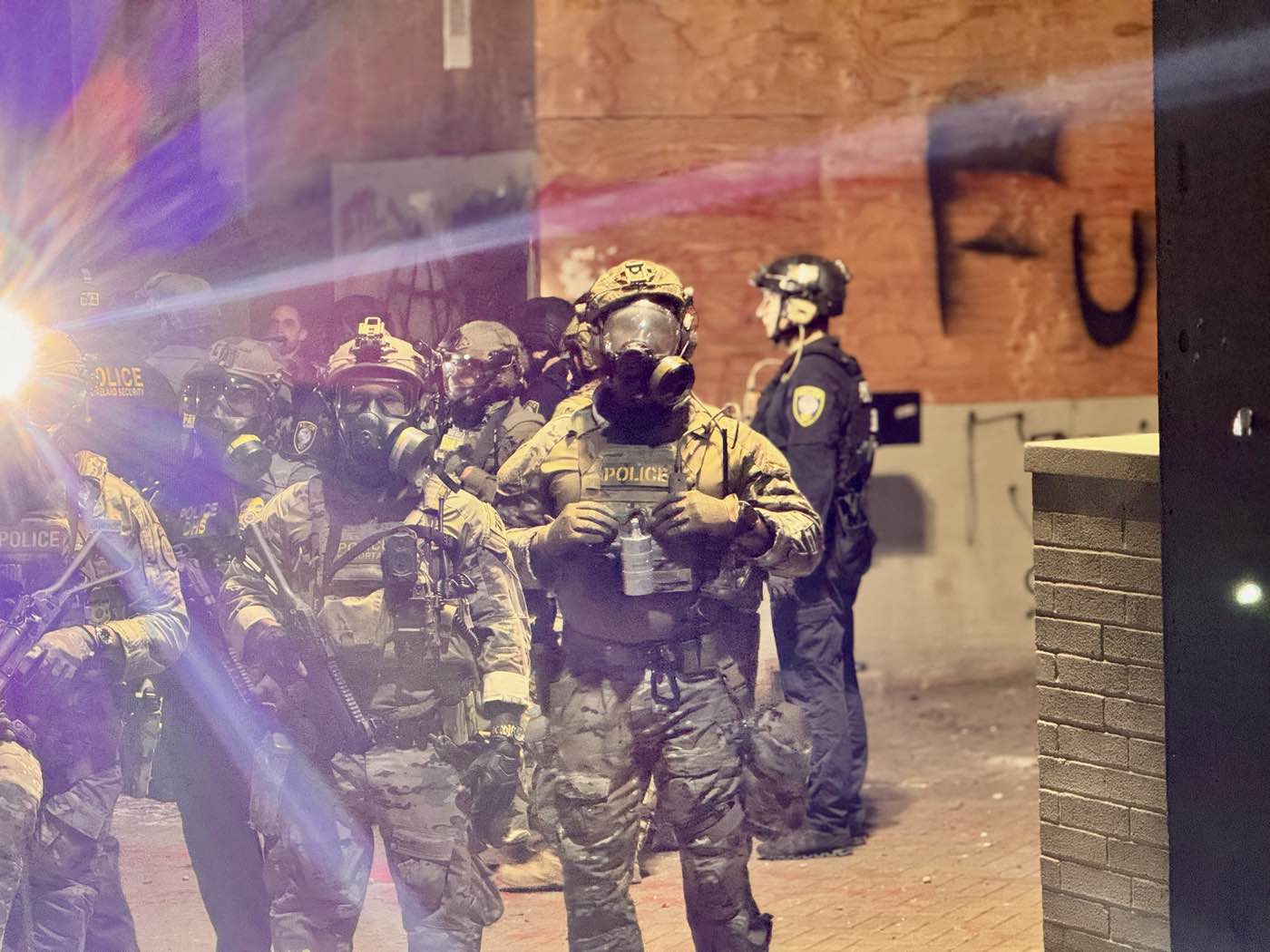
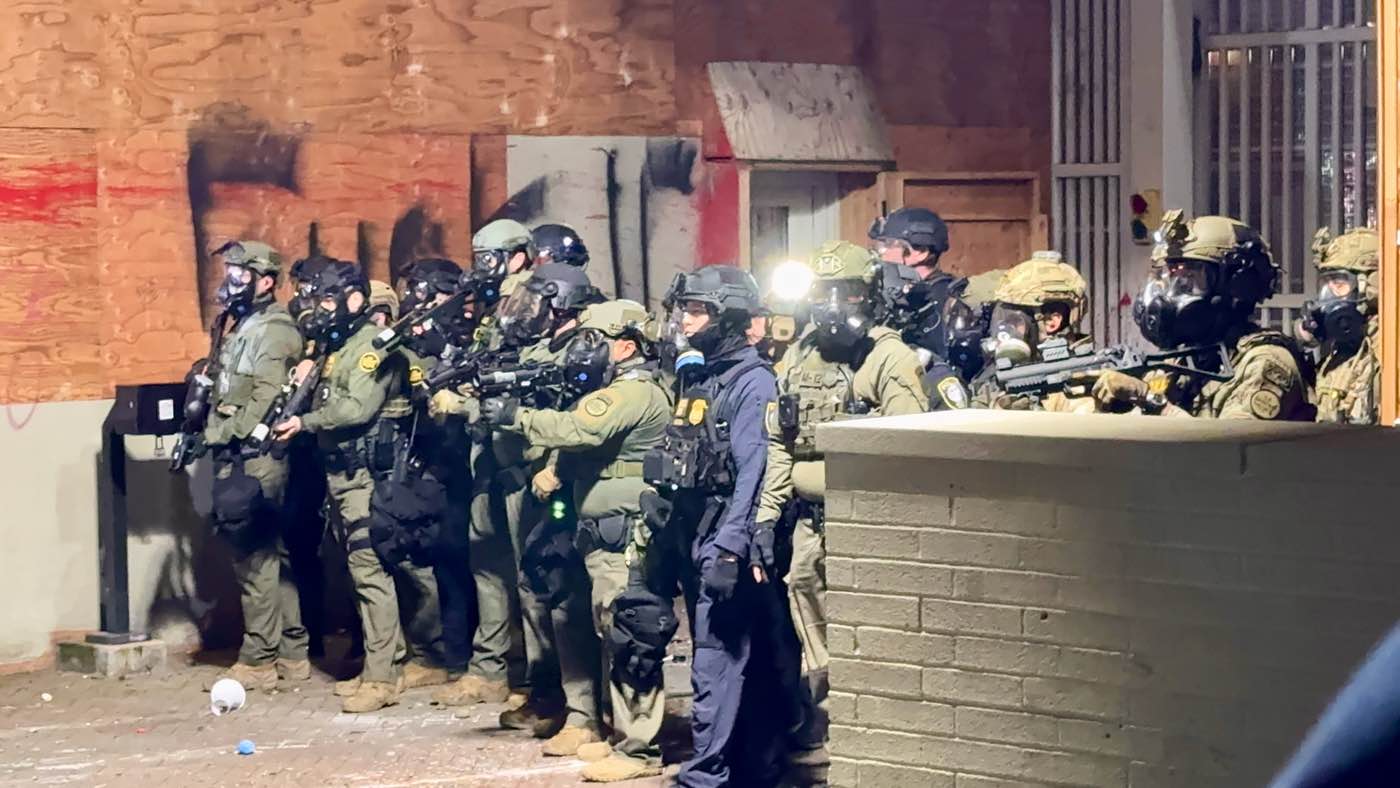
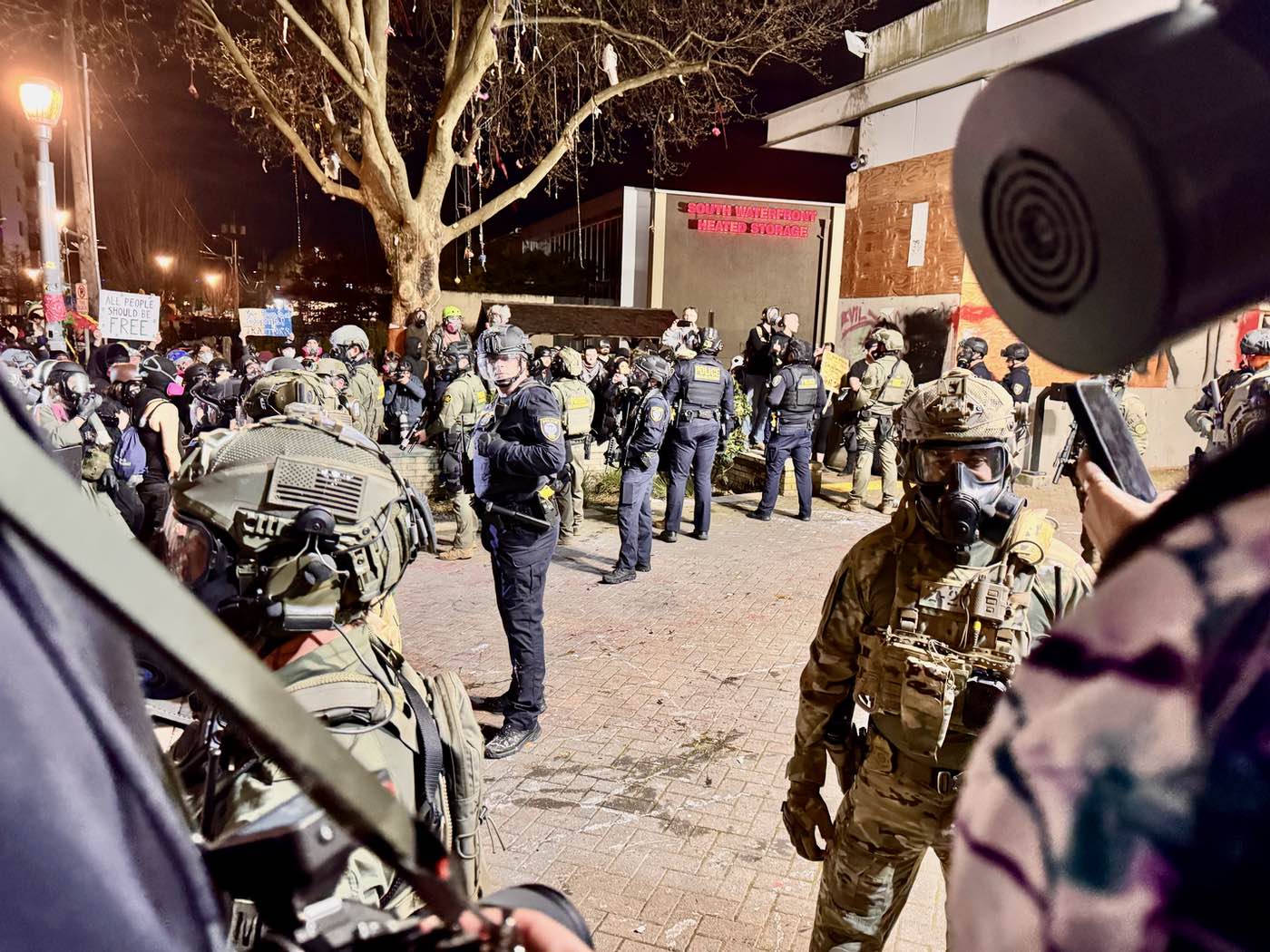
One federal mercenary displaying egregiously bad muzzle discipline.
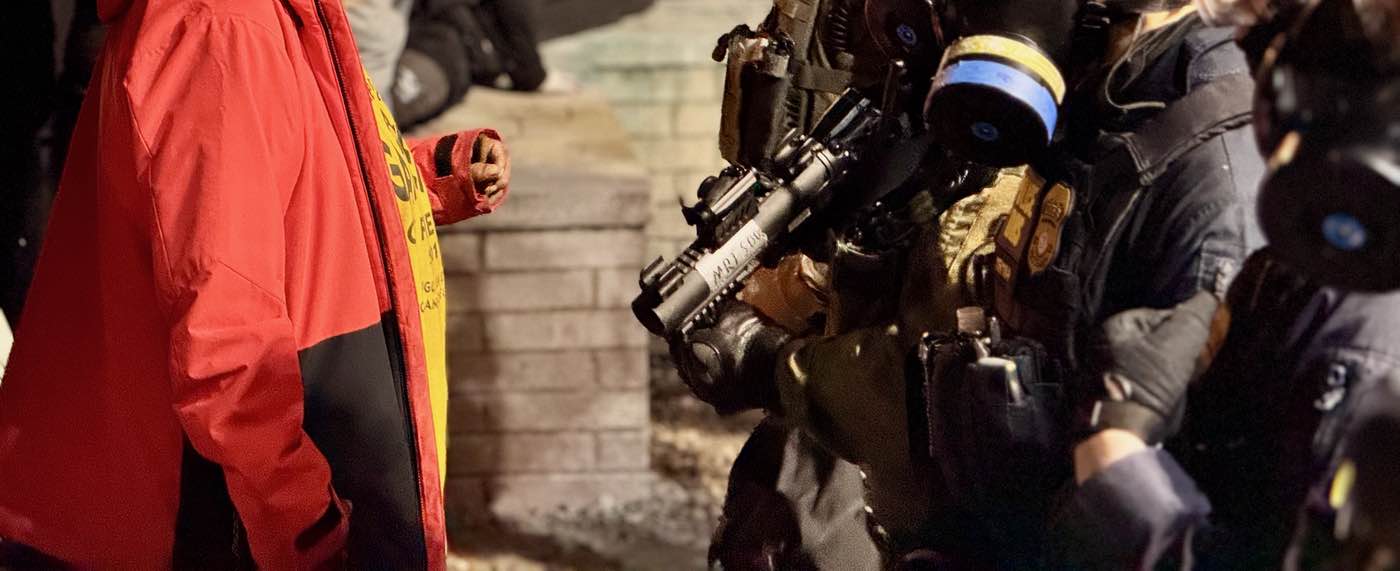
Protesters attempted to pull back those the officers targeted. They successfully de-arrested some people, despite being continuously obstructed by a wall of livestreamers and photographers raising their cameras.
Even then, however, the feds held back on using munitions. This was shocking, not what people have come to expect at the ICE facility. The officers moved in, made arrests, and retreated, only to experience another barrage of projectiles. Bottles, sticks, eggs, and other objects rained down until they disappeared behind their doors. While the restraint and lack of “less than lethals” on the part of federal agents was noticeable, this didn’t make the brutality of their arrests any less violent, as multiple arrestees were slammed down to the ground, piled on, and dragged away, and at least one officer pointed his loaded sidearm directly at people’s heads.
Throughout the night, a handful of far-right instigators were identified and forced out of the crowd. One of them was pummeled with water balloons filled with pink paint to the laughter and cheers of onlookers. Flags caught fire again—one American flag and one flag bearing a swastika. At one point, someone climbed onto the awning and dismantled a security camera piece by piece. This inspired people to take down several other cameras, pulling the wiring out.
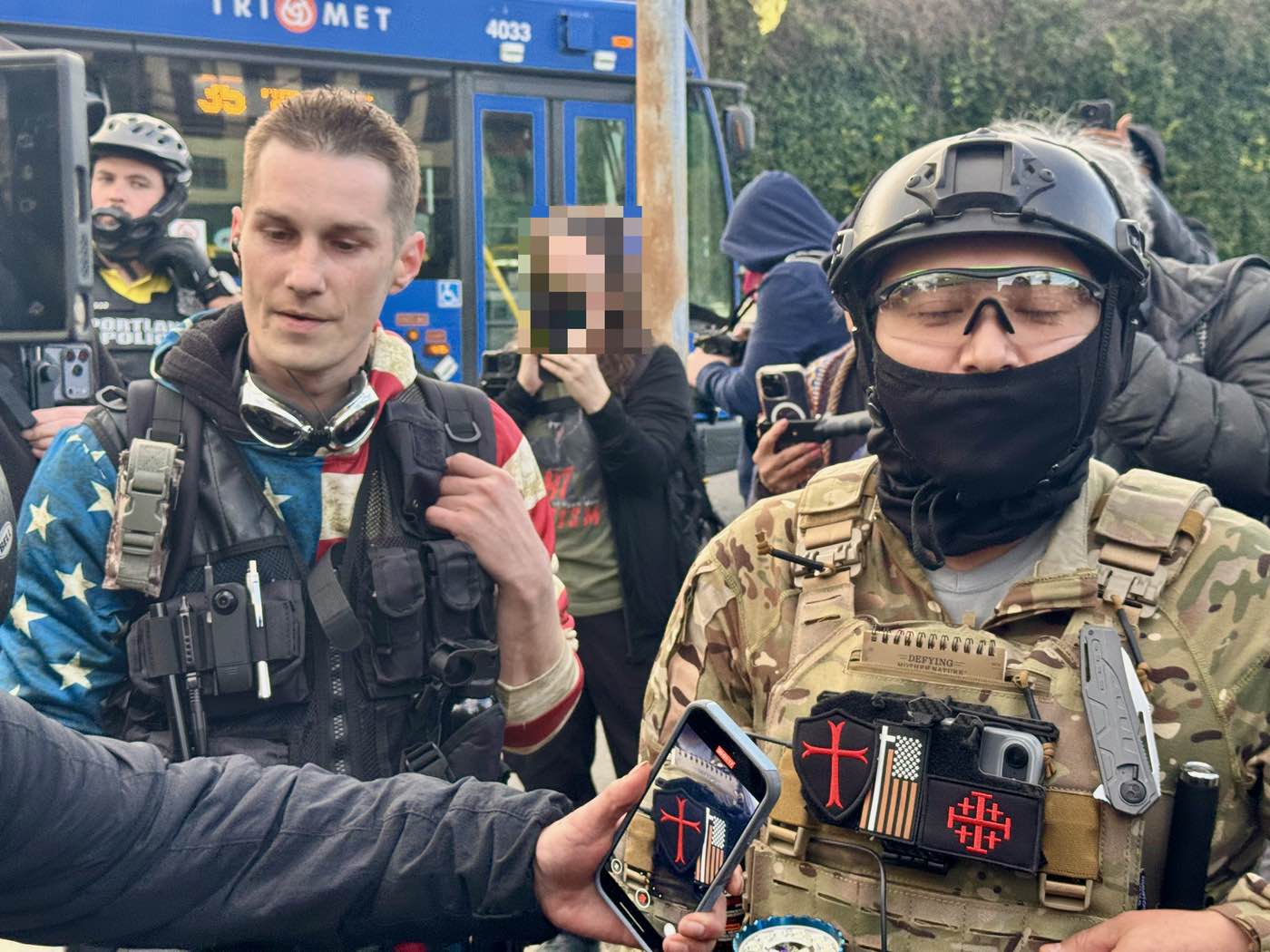
Why did federal agents show unusual restraint? Why were local police left to do the bulk of the crowd control? These remain open questions.
But one thing is not in question: people kept coming. They repeatedly crossed the blue line painted on the ground. They came back again every time federal agents attempted to push them back. Whatever strategy was unfolding behind those doors, it met with rage, defiance, and a refusal to back down.