Protecting Your Neighbors by Following ICE Vehicles
:A Guide from the Bay Area

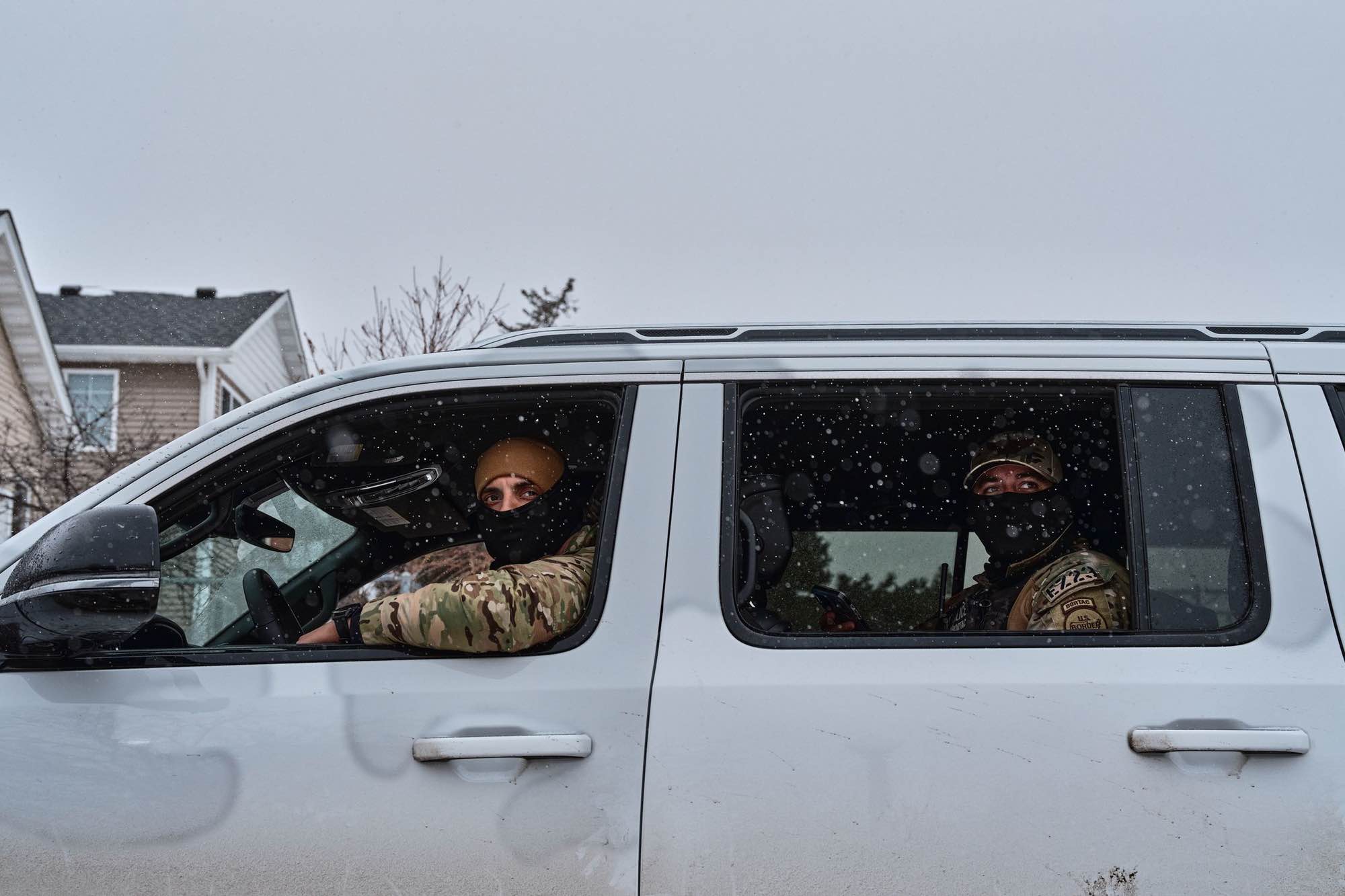
Over the course of the second Trump administration, people around the country have developed models for defending their communities from federal agents intent on kidnapping and terrorizing. We have shared guides from organizers in Chicago and the Twin Cities. In the same spirit, we present this guide to following Immigration and Customs Enforcement vehicles, developed in the Bay Area.
Emboldened by tens of billions of dollars of federal funding and effective impunity, ICE agents are murdering people in the streets at an accelerating pace. In the course of eight days, ICE agents have taken four lives—randomly gunning down men in Texas and Maine, neither of whom were even the target of their operations, killing another person in Georgia by denying him access to his medication, and chasing another to his death in Florida. They will keep killing people until there are significant consequences for them or those who direct them. We should organize to defend our communities, drawing together networks of people who are experienced taking action together, and look for opportunities to go on the offensive.
“Move ICE, Get out the Bay”
Hey, you! Yes, you.
YOU can counter state violence by following ICE vehicles.
Things are bad. The government is kidnapping and killing people.
It is going to get worse.
We see in Minneapolis and every other place fighting fascism that average people taking direct action can hinder and stop state terror.
Following ICE is a concrete way to make it harder for them to inflict violence.
This guide is a launching point for you to feel comfortable
a) responding to an ICE sighting
b) doing ICE watch patrol.
This guide is for you even if you don’t have a car. Cars need passengers. ICE followers need offsite support.
The Resistance needs YOU.
You can download the original zine version of this article here. It is addressed to the Bay Area context specifically.
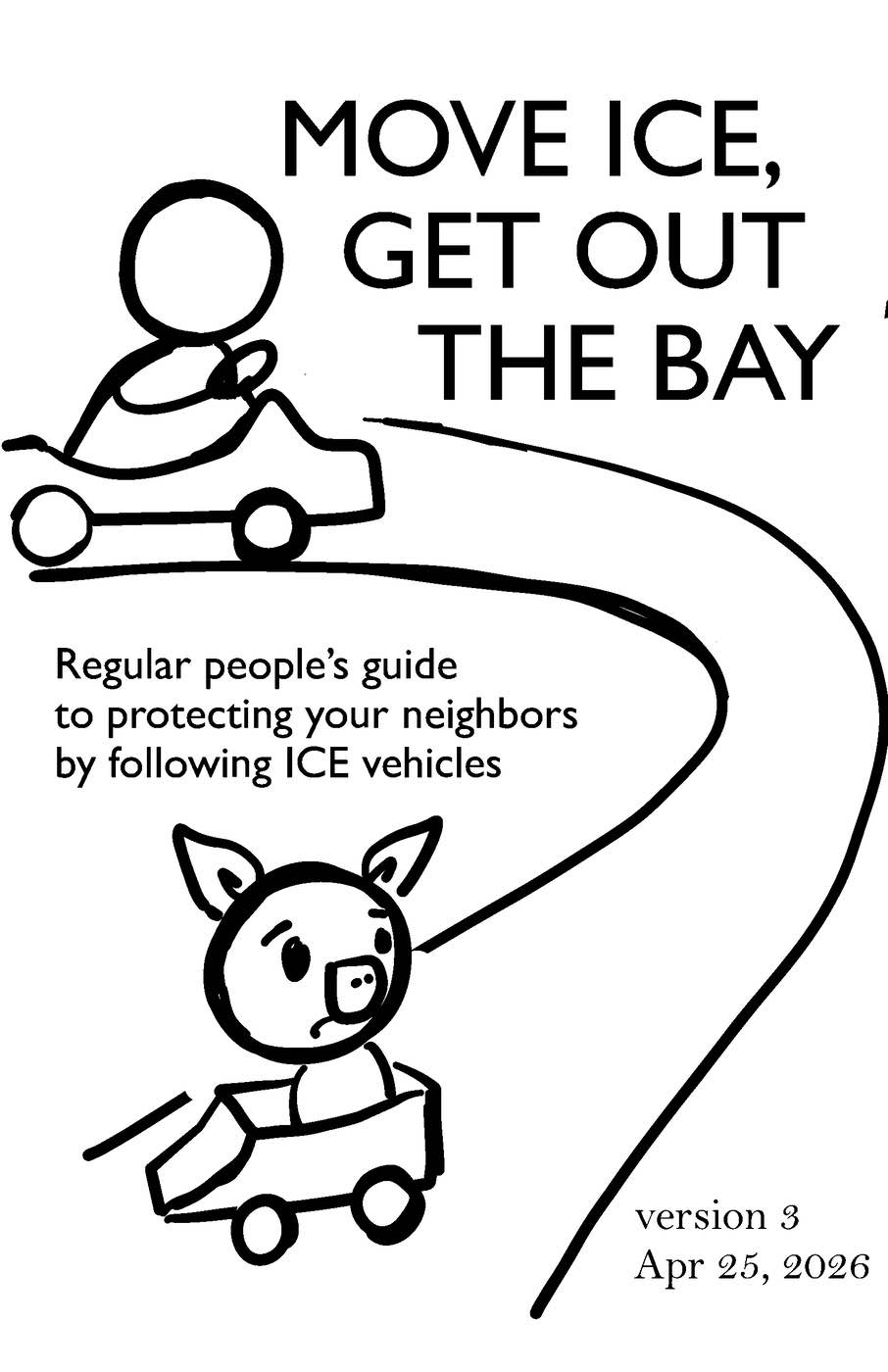
Steps You Can Take Right Now to Prepare
This guide is intended to help you to be as confident as possible, not to intimidate you. In the Twin Cities, everyday people did this work without the luxury of being prepared. You can act even without taking any of the steps in this guide.
However, if you have time now, it’s better to become ready so you don’t have to scramble to get ready later.
Set up Your Phone
Use Signal. You can find a helpful checklist for Signal security here.
- Choose username and profile
- Disable access to phone number
- Turn on disappearing messages
- Disable notifications preview
Disable location services on your phone.
Download a VPN. A good free option is Proton VPN.
Disable biometrics. Replace fingerprint and facial ID with a passcode of more than 8 random digits.
Extra credit: set up a secondary phone or burner phone. We recommend GrapheneOS on a Pixel 8+.
For more security tips, start here.
Prepare Your Vehicle
Remember:
- ICE can find the address to which a car is registered.
- Do NOT use someone’s car without their permission.
Consider:
- Tinting windows
- Mounting dashcams
- Recommend Garmin Mini 3 (turn off audio and disable cloud sharing)
- Remove anything that could increase risk in encounters with law enforcement, such as weapons or controlled substances.
Good things to pack:
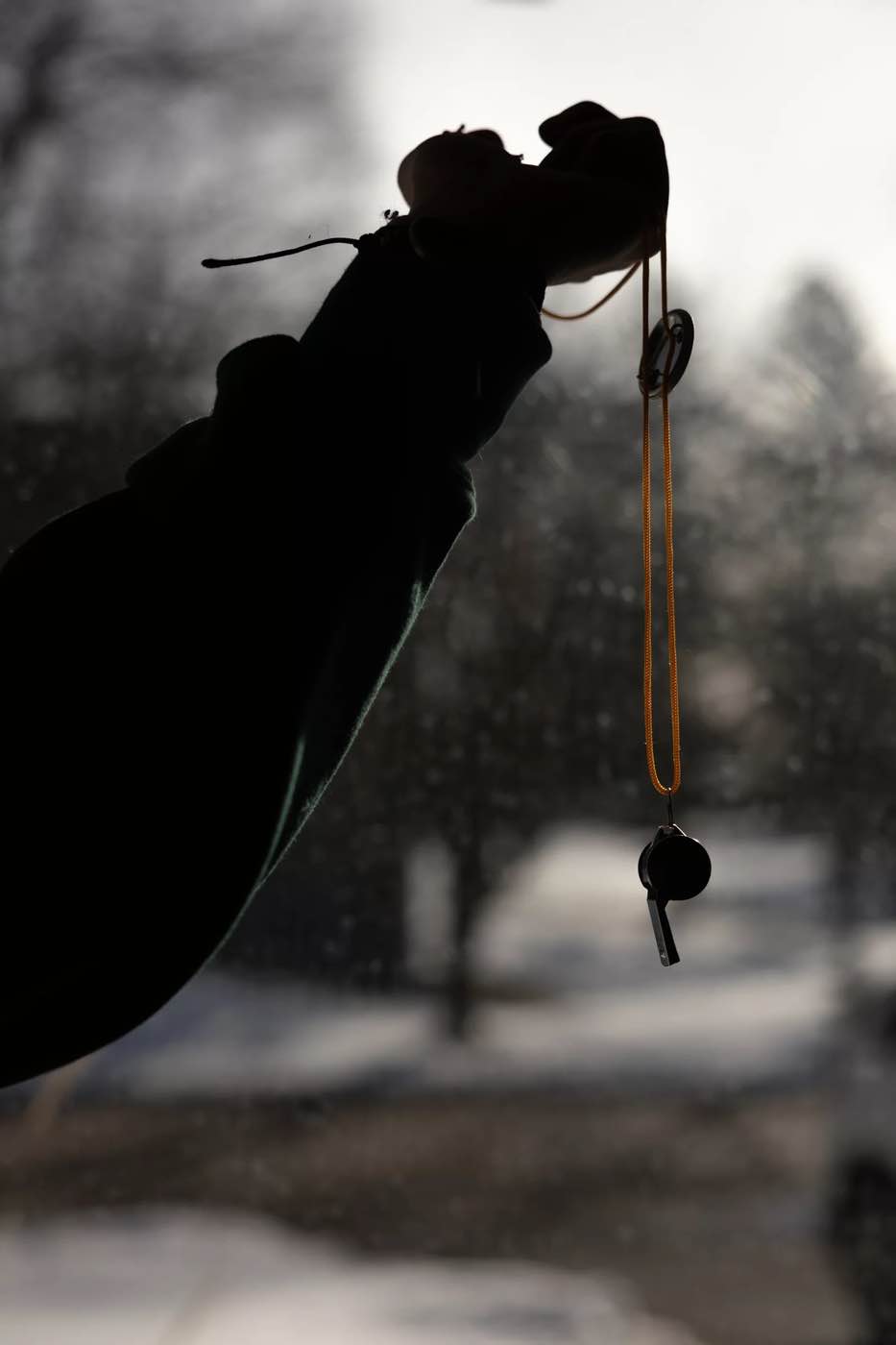
- A whistle or megaphone to activate the community
- A mask or sunglasses, to defy ICE’s facial recognition app
- A squirt-top water bottle filled with water—this can be used to flush eyes if you experience chemical weapon attacks
- A phone charger
- Snacks
- An individual first-aid kit and goggles
Gather Your People and Divide up Roles
- 1 driver
- 1-2 passengers
- 1 offsite dispatch (see below)
- Discuss the scenarios described below in advance with your crew so you know how you will respond. Plan together for each scenario.
Following ICE is not a crime. But it is better to be prepared for arrests just in case.
Each participant should make sure that a trusted person has the following information:
- The name and birthdate on your government-issued identification document(s)
- Instructions regarding what to do if you are arrested (for example, notify family or employer, pick up children from school, feed pet).
If there is a local jail support hotline, memorize the number. Otherwise, memorize the number of someone that you can call if you are arrested.
The ideal configuration is 3 cars with 3 people in each car, and 1 person offsite running dispatch. But people have done this with a lot less! At a minimum, you should aim for 2 people in 1 car and an offsite dispatcher.
Passengers
You can divide these tasks between two people (highly recommended) or, if necessary, one person can try to do both at once.
Phones Role:
- Communicate with the Dispatch person over a Signal call using the driver’s phone.
- Provide turn-by-turn updates. North/South/East/West is helpful, but Left/Right works in a pinch.
- Share information about suspicious vehicles.
- Narrate what the vehicle is doing; share information about the agents inside.
- Photograph suspicious or known ICE vehicles
- Help the driver navigate.
If the ICE vehicles park and multiple agents exit, or if you see other notable ICE behavior,
- Give the driver the call phone and use your own phone to record.
- Hold the phone horizontally while recording.
- Do not use social media live—the footage can be used to identify people and cannot be removed afterwards.
- Do not stop recording, even if ICE asks you to stop.
- Narrate the scene to the Dispatch person using the SALUTE protocol (see below).
Activator Role:
- While following agents, help to mute or unmute the call. Stay aware and be ready.
- If the ICE vehicle(s) park and multiple agents exit, you should stop and exit your vehicle. Make noise with your whistle or megaphone to activate neighbors.
- For example: “ICE is outside! You do not need to open your door for them. If you are in a position to do so, come outside to protect your neighbors.”
- Address yourself to a specific bystander and ask them to call the Rapid Response Network.
- If someone is detained,
- Ask for their emergency contact. ¿Quién es tu contacto de emergencia?
- Check in with their loved ones left behind and offer support. Let the emergency contact know what happened.
Driver Role:
- The driver has one job: driving. Nothing else! Do not bring children or pets.
- If ICE parks and multiple agents exit the vehicle, the driver should remain in the car in case it is necessary to drive away. Honk to get the attention of neighbors. Stay on the phone with dispatch and give verbal updates using the SALUTE protocol (see below).
Best practices for call with dispatch:
- Stay MUTED unless sharing information:
- Agree on short names to refer to vehicles. Use a different name for each follow car (colors work well). Choose a different name for each ICE vehicle, as well, using a different theme.
- Keep your contributions concise.
- Bad: “The silver Chevy Impala is uh, turning right… no, left…”
- Good: “Impala left on Market”
- Be mindful of how much space you are taking up in the call. Pay attention to who is talking before you interrupt.
- Use this hierarchy to determine who has the priority to interrupt: 1) Dispatch, 2) Car closest to the ICE vehicle relaying information, 3) Car relaying an emergency or need to leave, 4) Other.
For maximum clarity, learn the phonetic alphabet to report license plates over the phone—e.g., “Tango Yankee Charlie 666.”
Dispatch
You can run dispatch if you are
- Offsite, ideally in front of a computer
- Able to pick up a call within seconds
- Comfortable reading maps
- A member of local rapid response Signal groups
- Calm, level-headed, and able to multi-task
If you are handling dispatch:
- Start a Signal call on a chat with you and those who are following.
- Document the information that followers are sharing: e.g., turn-by-turn directions, vehicle information and license plate numbers, notable time stamps.
- Provide logistical support:
- Identify possible routes: e.g., “Looks like they’re heading to the Bay Bridge”
- Check suspicious license plates against the latest lists of ICE vehicle plates:
You can check plate registration here—if there is a mismatch, that indicates that the license plates have been swapped out, which is an ICE tactic frequently seen in the Twin Cities.
People in the Twin Cities set up this interface to check license plates against their continuously updated database of ICE vehicles.
- Decide when to alert community. Some signs it might be the right time: ICE vehicles exiting a highway, multiple ICE vehicles, multiple ICE officers in a single vehicle, ICE agents driving a known kidnapping vehicle.
- Write an alert and share it in the local rapid response chats.
Use the “SALUTE” protocol to convey information instead of inciting panic:
Size—number of vehicles/agents
Activity—for example, “idling inside vehicles” or “surrounding a home”
Location—with address if possible
Uniform—tactical gear and “DHS/POLICE/ICE” identifiers
Time
Equipment—for example, weapons, armored vehicles
Support needed—for example, “Community responders needed NOW!”
A good use of SALUTE protocol could read as follows:
3 ICE vehicles, including known kidnap van, spotted driving in the Mission at 8:12 am, Feb 10. Join this chat for more info or to help support. (INSERT LINK TO UPDATES CHAT). Do not forward after 10 am.”
Dispatch Duties
This role is difficult and complicated. Don’t be intimidated—just do your best. In some parts of the country, you should be able to connect with experienced dispatchers for training.
Create two Signal chats:
1) Active Following: The first chat is for those who are actively following ICE agents. Choose an innocuous group name.
- When the driver(s) join the chat, start an audio call.
- Stay on the phone with the people in the car.
- If someone from the “Updates” chat arrives on site with a car and begins following, add them to this chat so they can join this call.
2) Updates: This is to connect people offsite to information as it becomes available.
- Include the link to the “Updates” chat in the alert you share via rapid response networks to connect those who can support to the action.
- Share relevant updates. This chat can serve as log with automatic time stamps. Answer questions as best you can.
- Remind people to limit chatter in order to keep the chat open. Remove anyone offsite who is clogging up the chat.
Follow up after the fact:
- Contact local rapid response networks to report attempted or successful abductions.
- Save your notes or log from the day and share it with the groups documenting ICE activity and license plates in your area.
- Remove the participants from all the Signal chats and leave the chats in order to fully delete them.
Handoffs
When you first start following ICE, they will know that you are behind them. They will be driving erratically, cutting across multiple lanes of highway to lose you. In a “handoff,” a dispatcher finds a second car to take over following the ICE vehicle. The second car gets behind you, and then you pretend to let ICE lose you. The second car can then follow the ICE vehicle undetected for some period of time. This is a key function of a dispatcher.
In the Twin Cities, handoffs have been essential in enabling activists to follow ICE agents from their headquarters at the Whipple Federal Building to their destinations.
cdn.crimethinc.com/assets/articles/2026/07/16/2.jpg
What Would You Do?
Here are some tactics ICE has used when people are following them. Assess what risks you are willing to take and discuss everything with your crew in advance so you can respond in a coordinated way that works for all participants.
Remember, you are not alone—you have dispatch and your trusted team to help you make decisions. All you can do is your best. There is not always a right decision in these moments.
It’s important to weigh the risks of the ICE vehicle getting away against the risks of continuing to follow them.
Some scenarios we’ve seen and decisions you should make in advance:
- Erratic Driving (sudden changes in lanes, running red lights, speeding, etc.)
- Breaking traffic laws exposes you to legal risk.
- Getting into an accident could physically harm others as well as yourself.
- Driving to a Registered Address
- In the Twin Cities, ICE has run the plates of cars following them and driven to the residence at which the vehicles are registered as a means of intimidation.
- If ICE agents are threatening you, drive to a public place.
- Box-ins (another ICE tactic seen in the Twin Cities)
- ICE agents have used their vehicles to deliberately box in responders, surrounding and trapping them as a means of intimidation.
- Ensure that your doors are locked and your windows rolled all the way up.
- Stay on the phone with dispatch and ask for more support. Record the entire interaction.
- Often, it goes most smoothly when those observing ICE agents ignore their tantrums completely and don’t react.
- If boxed in, ignore the agents and focus your time and attention on calling in support.
- You can calmly state: “I am driving on a public road. I am observing and recording. I am not impeding or interfering.”
- Using multiple vehicles to stop you
- ICE may call for backup when cornered, summoning other federal vehicles to escort the original vehicle away.
- Attempting to block vehicles with your vehicle could lead to obstruction charges.
- Don’t let them intimidate you! If they try to block your car, you’re allowed to drive around them.
- Pulling over onto the shoulder of the highway
- If you stop behind them, the police will come; they’ll ticket you and let the ICE agent go.
- This is one of their most effective ways of shaking you if they can’t lose you with erratic driving.
- Sending out decoy vehicles to lead you on a wild goose chase
- In the Twin Cities, where ICE agents would use this tactic, drivers prioritized following vehicles with more than one agent inside, or in which the agents were wearing tactical gear—those are more likely to be going to an abduction.
You can find resources for recognizing ICE vehicles in the Bay Area here.
Staking out ICE
You can stake out ICE at a building or garage and follow their vehicles when they leave. Doing so can also give you valuable information about how ICE operates.
Assemble Your Crew
- Observers (2)
- At least 2 cars with drivers and passengers. Consider renting a car for an additional layer of security.
- A person to run dispatch offsite.
Scout the Location
Identify good locations for:
- Foot observers to watch the doors or gates;
- ICE followers to park and be ready to follow cars that leave;
- Observers to note when cars tend to leave for raids (we recommend posting up in the early morning);
Locate the nearby bathrooms, while you are at it.
Observers
A picture is worth a thousand words!
Observers should capture the following details about ICE vehicles:
- License plates
- Make/Model/Color
- Fleet numbers
- Damage
- Logos
Sit or stand where you can see the cars moving in and out. Cover your body, face, and hair. Work in pairs so you can take breaks without missing anything.
Track vehicle movements. Send messages immediately as they arrive and depart. Note the timestamps.
Track people entering and exiting. You can find tips on how to identify ICE agents and vehicles here.
- Describe the ICE agents, including clothing, height, gender presentation, build, ethnicity, tattoos, and other identifying features.
- Take photographs if possible.
If you see a vehicle leaving, enter the vehicle information in the chat immediately, including the direction it is driving.
Continue observing in case more federal vehicles come out.
Dispatch
A dispatcher can perform the following tasks to support those staking out ICE at a building or garage:
- Create and administer Signal chats. In addition to setting up “Active Following” and “Updates” chats, create an “Observation” chat including the observers and those who begin following ICE agents in vehicles.
- Log all the information that observers send you.
- As soon as the watch period starts, start a Signal call in the “Active Follow” chat so you can verbally relay information from the “Observation” chat to the followers.
- Help the followers make decisions (see below).
- Send your log to the groups documenting ICE activity and license plates in your area.
Make note of which vehicles have been seen at the scene of abductions and prioritize following those. Not every known ICE vehicle is tasked with Enforcement & Removal Operations. Some of them are for administrators, surveillance operations, Homeland Security Investigations, or other purposes. Prioritize following the ones that have been observed kidnapping people.
Followers
Position your car where you can follow any vehicle exiting the facility, whichever way it turns. Take note of one-way streets in the area.
Wait patiently: Keep track of the chat and be ready to move. Stay hydrated and well fed but take care not to need a bathroom break at the wrong time.
When you get a message that a vehicle is leaving, follow it! Join the dispatch call. From there on, carry out the regular follow process described above.
Which vehicles are worth following?
- Vans with Department of Homeland Security plates
- Other vehicles with 2+ agents inside, especially if they’re in tactical gear.
- Multiple vehicles leaving at once.
How many cars should follow them?
- It is best to send at least two vehicles to follow ICE vehicles. This is even more important when following multiple ICE vehicles.
- It is ideal for some drivers to stay behind at the observation site, in case more ICE vehicles leave.
When should the stakeout end?
- Bear in mind the stamina of observers and followers. Organize shifts if need be.
- Raids are somewhat less likely to begin after 9 am, though it is still possible.
- Observation is worthwhile even when there are no followers available, because it enables you to track patterns.
cdn.crimethinc.com/assets/articles/2026/07/16/4.jpg
Rights and Risks
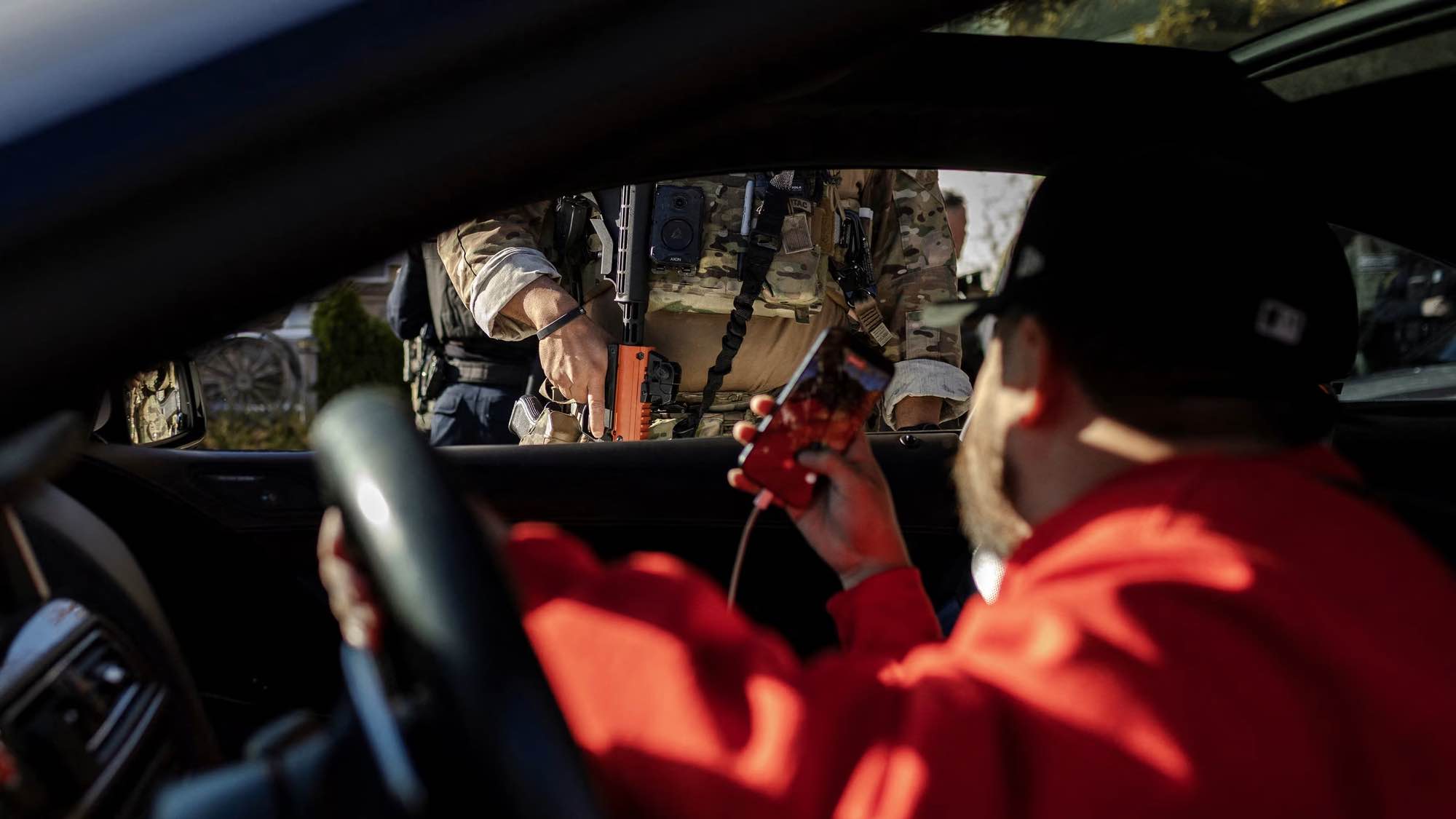
If ICE agents approach you, record the interaction if at all possible.
The law stipulates you have rights when interacting with officers. Unsurprisingly, mercenaries don’t always adhere to the law. Knowing and asserting your rights won’t necessarily protect you. But learning your rights can help you feel confident in asserting them, which could help in a legal case.
The 4th Amendment protects against unreasonable search and seizure. The 5th Amendment protects against self-incrimination.
- Ask “Am I free to go?”
- If they explicitly assert that you are not free to go, ask “Why am I being detained?”
- Assert “I do not consent to a search of my car. I do not consent to you searching my belongings or going through my pockets.”
- Assert “I am asserting my 5th amendment rights to remain silent.”
- Stay silent and refuse to answer any questions.
- Every time an officer tries to speak with you, reassert that you are using your 5th amendment rights.
The ICE officer says that they are not detaining me, but asks me for my ID or to step out of the car. Should I?
Discuss these questions with your crew in advance:
- Will complying make it less likely for them to detain or attack you? There is no way to know for sure. We have seen ICE agents attack even the most compliant. Consider the officers’ demeanor, your own situation, and what you’re ready to risk.
- Would complying make their job easier? Asserting your rights could potentially make it easier to defend yourself in a criminal case or to build a stronger civil suit, especially if they’re acting outside their authority.
Does observing ICE put me at risk of being criminalized?
- It is legal to follow and observe government employees. An officer can say and do whatever they want to create a charge against you, but there are legal resources available to help you fight these attempts to scare and silence you. Engaging in purely legal activity may protect you from being convicted, but it will not protect you from being charged.
- You may be charged with interfering with government employees’ official duties or harassment/intimidation.
- The authorities can and do use charges and arrests as an intimidation tactic, levying charges that are not supported by any evidence. In many cases, these trumped-up charges get dropped or do not appear on a record.
- All other daily legal risks apply here, including traffic laws and possession of illegal items. The additional risk is that the agents of the state will go out of their way to pursue any charges in retribution for your lawfully following and observing ICE.
cdn.crimethinc.com/assets/articles/2026/07/16/1.jpg
Further Reading
- When the Feds Come to Your City: Standing up to ICE—A Guide from Chicago Organizers
- Rapid Response Networks in the Twin Cities—A Guide to an Updated Model
- From Rapid Response to Revolutionary Social Change—The Potential of the Rapid Response Networks
- Minnesota Community Response Resources
- Activist Checklist—Security tips
- How to Identify ICE Agents and Vehicles